 Pyeongye
Artwork · 17th century · Gerard ter Borch the Younger
LeoTurn on Magnifier at the lower right and move slowly across the painting.
Full screen opens it edge to edge.Tap the painting to fill the screen.
Spread two fingers to look closer.
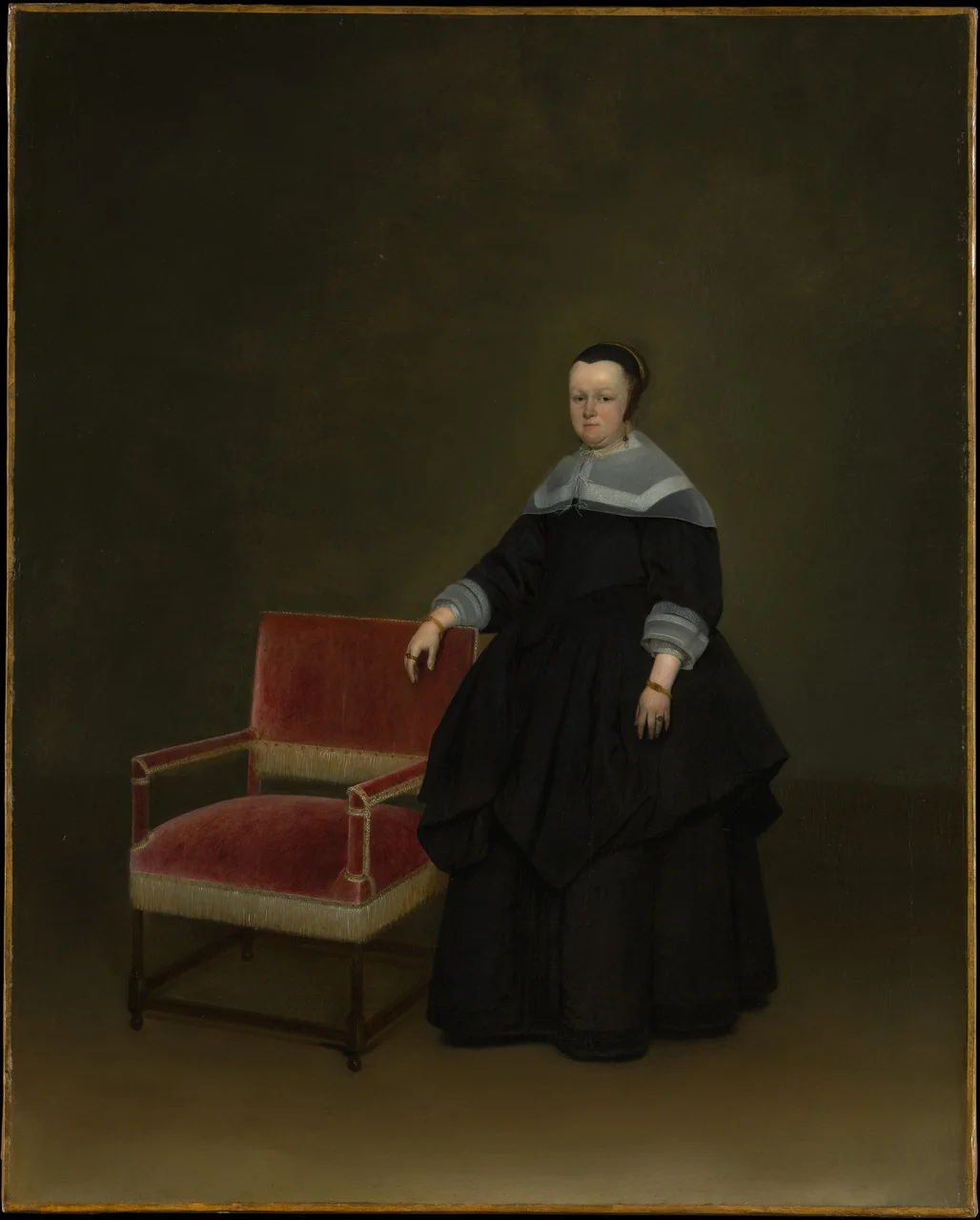
Margaretha van Haexbergen (1614–1676)
Gerard ter Borch the Youngerca. 1666–67Oil on canvas81.3 × 65.1 cm
At a glance
- Margaretha van Haexbergen, dressed in black, stands in a bare room with one hand resting on the back of a red chair.
- Gerard ter Borch, who worked in the Dutch town of Deventer, painted her in oil on canvas around 1666 to 1667.
- The figure is small and the rest of the canvas is nearly empty, so little things such as a sheer collar, a gold bracelet, and the fringe on a chair start to look large.
Reading the picture
4 places to look closer
Tap a number on the painting to jump to its note, or a close-up to see that spot in the whole picture.
Zoom in on her face. A thin gold band edges the black cap that covers her hair, and pearl earrings hang from her ears. A faint pink warms her cheeks, and her mouth is pressed shut. She was born in 1614, so she was just past fifty here.
Look at the white collar over her shoulders. The fabric is so thin that the black dress shows through as gray. A fine cord is tied in a bow at her throat, and a pattern glimmers along the collar's edge. Ter Borch was famous for this kind of skill, painting exactly how thick or thin a fabric is.
Zoom in on the hand on the chair. A gold chain bracelet circles her wrist, and a jeweled ring sits on her finger. Her fingertips rest lightly on the red velvet, with no tension at all.
Now look at the seat of the chair. Gold fringe hangs thickly around the red velvet cushion, and tiny gold studs run along the edge of the armrest. No one is sitting in it, yet the light makes it look warm.
When it was painted
Around 1666, Gerard ter Borch was forty-nine. He was born in Zwolle in 1617, the son of an artist, and he started drawing when he was very small. His father saved the boy's drawings instead of throwing them away. That bundle survives today in the Rijksmuseum in Amsterdam.
As a young man he moved around to learn his trade, in Haarlem, in London, and elsewhere. In 1648 he was in Münster, where he painted Dutch and Spanish envoys swearing to a peace treaty. In 1654 he married in Deventer and settled there for good, painting many of the town's leading citizens.
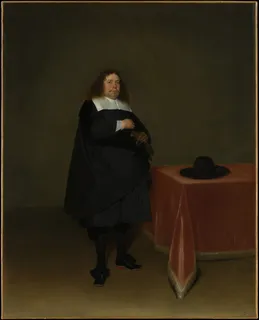
The man who ordered this portrait was Margaretha's husband, Jan van Duren. He belonged to the small group of families that ran Deventer. His own portrait, Burgomaster Jan van Duren, hangs in the same museum. The two pictures were made as a matched pair, husband and wife.
Then the paintings stayed in the family for a very long time. They passed to the couple's son Damiaan and then to his daughter Elisabeth. When Elisabeth married Martinus van Doorninck in 1738, the portraits went with her into his family, and the van Doornincks still owned them in the early 1900s. Later they joined Robert Lehman's collection, which came to the Met in 1975.
So she is still near her husband today. Look again at her hand on the back of the chair. For more than two hundred years, on the walls of her descendants, that hand rested lightly on the red velvet.
More by the same painter
Questions to think about
- Look for itCan you find the bracelet and ring on her other hand, the one hanging down on the right side of the picture?
- Why?Why do you think Ter Borch left the room almost empty, keeping just one chair?
- What about you?Margaretha chose black and a white collar instead of bright colors. When you have an important photo taken, what do you want your clothes to say about you?
Same period
Painted around the same time,
somewhere else
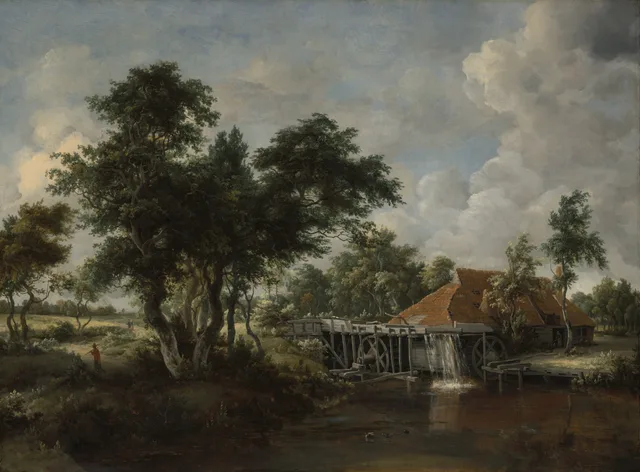 The Watermill with the Great Red RoofMeindert Hobbemac. 1665
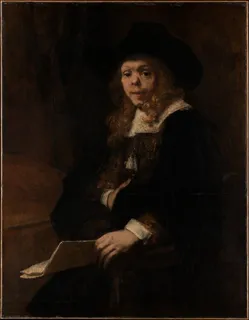 Portrait of Gerard de LairesseRembrandt1665–67
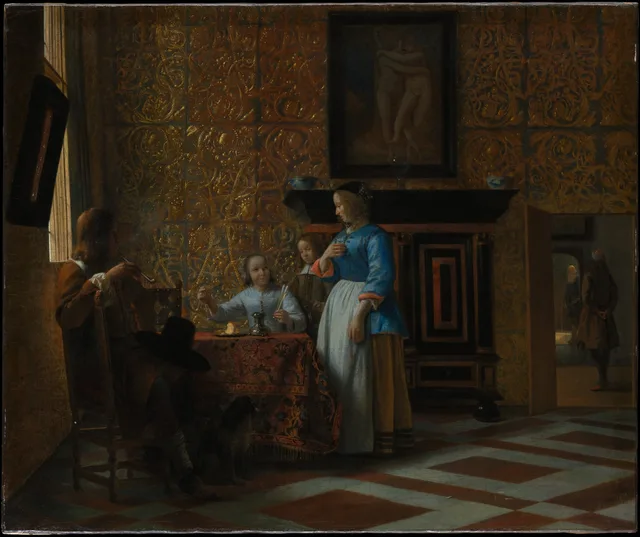 Leisure Time in an Elegant SettingPieter de Hoochca. 1663–65
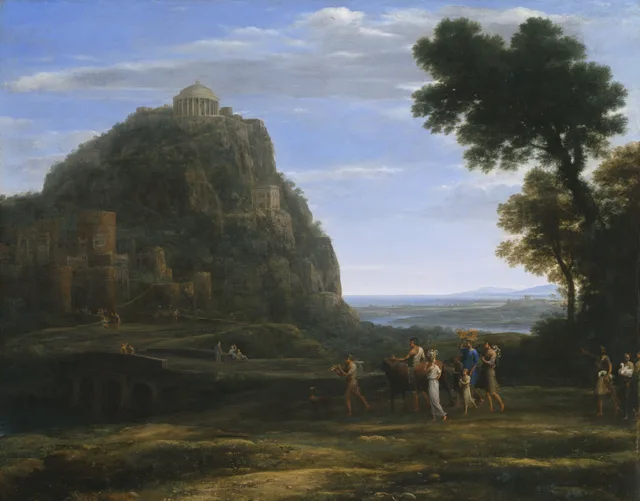 View of Delphi with a ProcessionClaude Lorrain1673
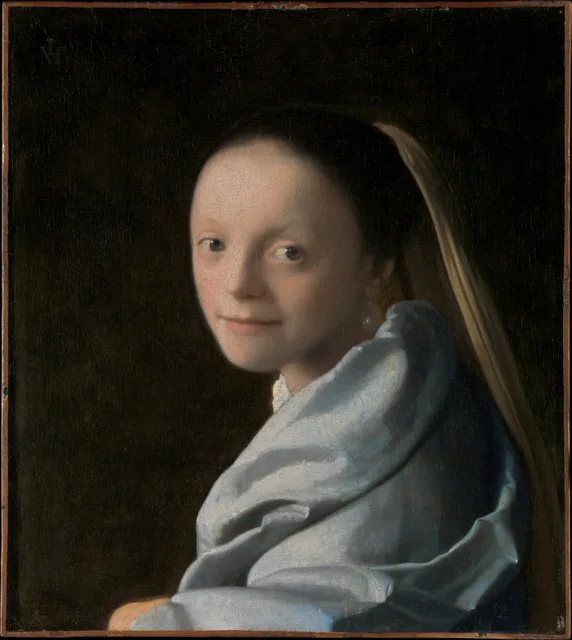 Study of a Young WomanJohannes Vermeerca. 1665–67
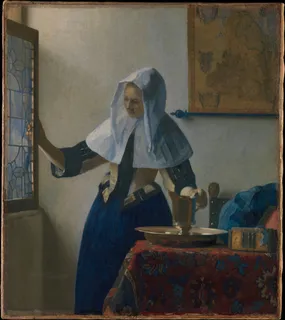 Young Woman with a Water PitcherJohannes Vermeerca. 1662
Too good to keep to yourself
This painting,
for someone who comes to mind
They open it at full size
and see every brushstroke.
About this work
- Artist
- Gerard ter Borch the Younger · 1617–1681
- Date
- ca. 1666–67
- Medium
- Oil on canvas
- Size
- 81.3 × 65.1 cm
- Collection
- The Metropolitan Museum of Art
- Image
- Original long edge 3721px · shown at 2560px
- Original
- View on the museum's website ↗