Pyeongye

Painters · 17th century
Gerard ter Borch the Younger
1617–1681
A Dutch painter famous for the shimmer of satin and the depth of black cloth, who recorded a peace treaty being sworn and the faces of his neighbors in Deventer on small, quiet canvases.
Scenes from a life
The life of Gerard ter Borch the Younger,
scene by scene
- 1625Zwolle
On September 25, 1625, in a house in the Dutch town of Zwolle, seven-year-old Gerard makes a drawing. His father, Gerard ter Borch the Elder, writes the date on the sheet. The father was a painter too, and he labeled and kept his children's drawings.
The family's bundles of drawings were kept by Gerard's half-sister Gesina and later generations of the family. In 1886 the Rijksmuseum in Amsterdam bought them. The boy's drawing from 1625 is there today, the earliest known work by his hand.
- 1635London
At seventeen, Gerard is staying in London with Robert van Voerst, an engraver and the brother of his stepmother. Van Voerst had recently been named engraver to King Charles I.
That summer, his father wrote to him from Zwolle. The letter still survives, and it is how we know he was in London that year. Van Voerst died the next year, and Gerard came home to Zwolle in 1636.
- 1648Münster
On May 15, 1648, in a room of the town hall in Münster, Dutch and Spanish envoys raise their hands and swear to a peace treaty. Eighty years of war between the Dutch and Spain are over. Ter Borch, who was in Münster at the time, painted the scene in oil on a sheet of copper.
The picture is less than two feet wide, yet it is packed with envoys and onlookers. At the far left the painter put himself in, with a reddish moustache and long fair hair, looking straight out at us. The painting now hangs in the National Gallery in London.
- 1654Deventer
On February 14, 1654, the thirty-six-year-old ter Borch marries in Deventer. His bride, Geertruyt Matthys, was a widow and the sister of his stepmother. He settled in the town and lived there for the rest of his life.
Around this time he painted a young woman in a gleaming silver satin dress, standing with her back to us in a quiet room. More than 150 years later, Goethe described the scene in his novel Elective Affinities as a father gently scolding his daughter. For a long time the picture was known as The Paternal Admonition.
- 1666Deventer
In 1666 ter Borch joins the city council of Deventer, representing one of the town's districts. He held the post until his death. The well-known painter now helped run the town.
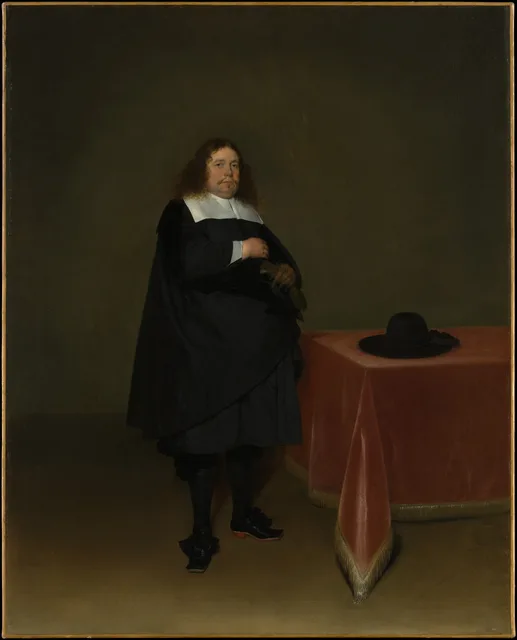
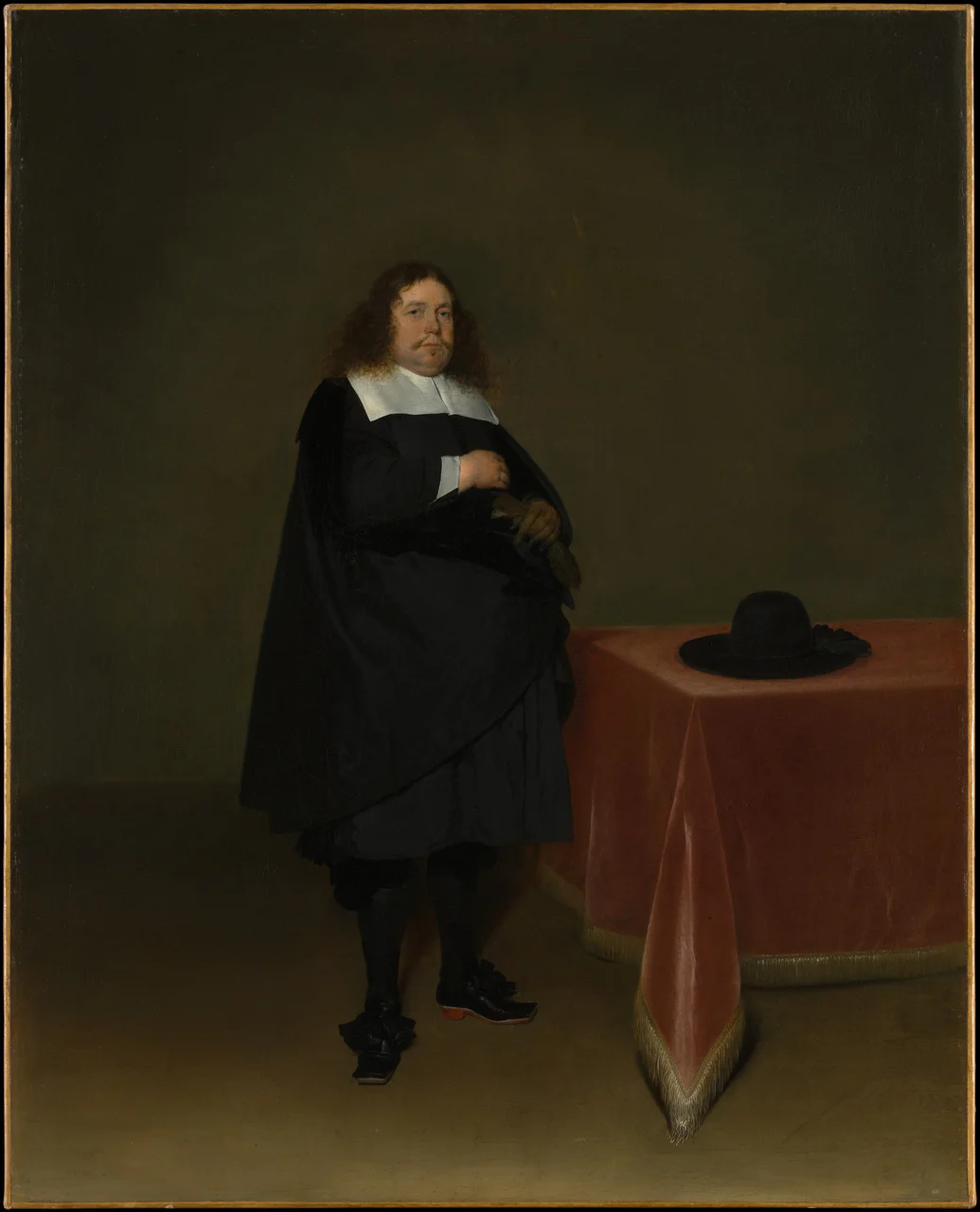
Around the same time, the burgomaster Jan van Duren ordered a matching pair of portraits of himself and his wife. Van Duren stands in an empty room, dressed in black, holding a glove he has just taken off. On the red tablecloth to the right lies a broad-brimmed black hat.
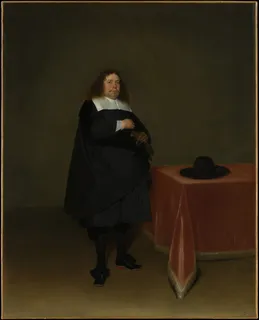 Painted around this timeBurgomaster Jan van Duren (1613–1687)
- 1667Deventer
In 1667 Gerard's youngest half-brother, Moses, is killed in the war with England. He was twenty-two. Gerard and his half-sister Gesina painted a full-length memorial portrait of him together. Gerard painted Moses, and Gesina painted the objects around him.
The portrait of Van Duren's wife comes from these same years. Margaretha wears black with a sheer white collar and rests one hand lightly on the back of a red velvet chair. A gold bracelet glints at her wrist, and golden fringe hangs thick around the chair.
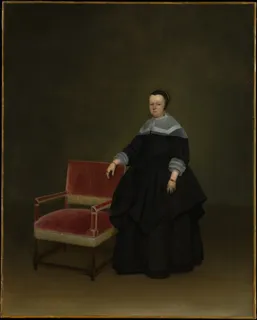 Painted around this timeMargaretha van Haexbergen (1614–1676)
- 1681Deventer
On December 8, 1681, ter Borch dies in Deventer. His wife Geertruyt had died before him, in 1672.
The Van Duren portraits stayed with the couple's descendants for more than two hundred years. In 1912 the American banker Philip Lehman bought the husband's portrait, and the pair became part of the Lehman family collection. In 1975 both came to the Metropolitan Museum, where husband and wife are still together, more than three centuries on.
People around them
- Gerard ter Borch the Elderhis father and first teacher, who dated and saved his childhood drawings.
- Gesina ter Borchhis half-sister, who painted alongside him and kept the family's drawings.
- Robert van Voersthis stepmother's brother, an engraver who took him in in London in 1635.
- Geertruyt Matthysthe widow he married in Deventer in 1654.
- Moses ter Borchhis youngest half-brother, killed in the war with England in 1667.
- Jan van Durenthe Deventer burgomaster who ordered portraits of himself and his wife.
Works