Pyeongye
Painters · 18th century
Giovanni Battista Tiepolo
1696–1770
A Venetian who filled palace ceilings in Italy, Germany, and Spain with bright skies, clouds, and figures that seem to float overhead.
Scenes from a life
The life of Giovanni Battista Tiepolo,
scene by scene
- 1719Venice
On November 21, 1719, the 23-year-old Tiepolo quietly marries Cecilia Guardi. Her brothers Gian Antonio and Francesco would become well-known painters. For a long time, biographers thought the wedding took place around 1721.
Then the 1719 marriage record turned up and set the date straight. The couple had married in secret. Two of their sons, Domenico and Lorenzo, grew up to work beside their father.
- 1726Udine
In 1726, Dionisio Dolfin, Patriarch of Aquileia, calls the thirty-year-old Tiepolo to Udine. He wants the staircase and rooms of his palace covered with frescoes. The work went on until 1729.
On those walls Tiepolo painted Old Testament stories of Abraham, Isaac, and Jacob. The frescoes are still in the palace in Udine today.
- 1740Milan
In 1740, in the Milan palace of the noble Clerici family, Tiepolo climbs up to the ceiling of a long gallery. His subject is the chariot of the sun god racing across the sky. At forty-four, he is a ceiling painter wanted far beyond Venice.
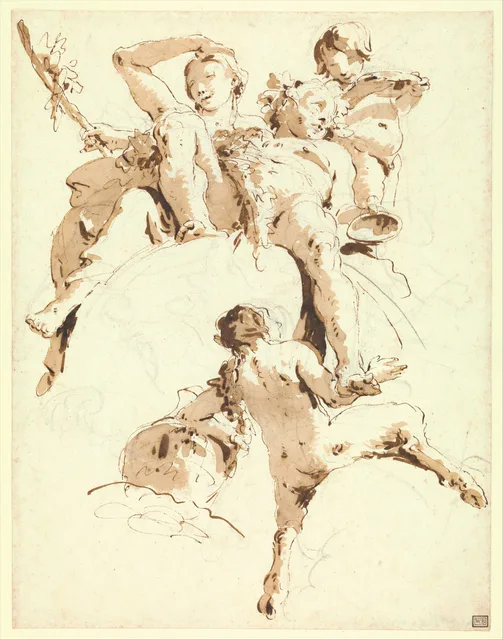
He was quick on paper, too. In Bacchus and Ariadne, a few pen lines and washes of thin ink are enough to catch bodies seen from below, as if we were looking up at a ceiling.
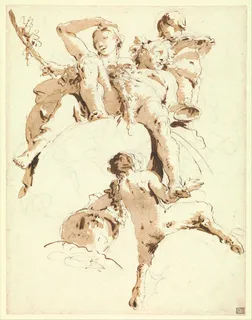 Painted around this timeBacchus and Ariadne
- 1744Venice
On March 5, 1744, Tiepolo is paid 300 gold zecchini for his Banquet of Cleopatra. The buyer is Francesco Algarotti, a writer who is collecting paintings for Augustus III, Elector of Saxony and King of Poland. The canvas is soon shipped off to Dresden.
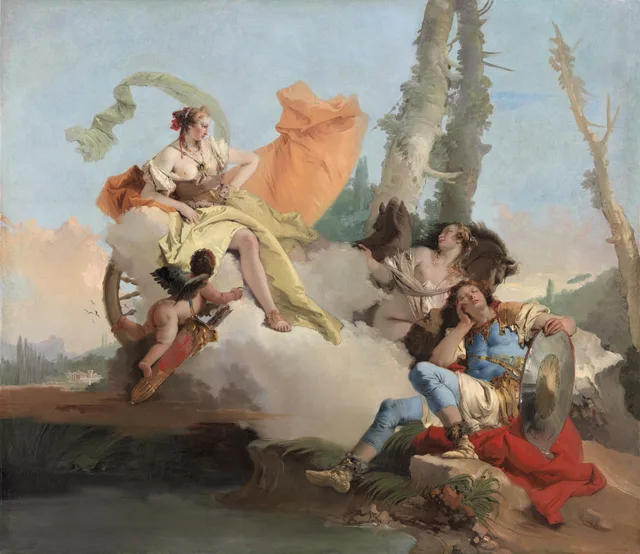
Around this time he also painted a series that likely once decorated a large hall in the Venetian palace of the Cornaro family. Armida Encounters the Sleeping Rinaldo is one of them. The sorceress Armida, her orange cloak streaming, sits on a cloud with a chariot wheel beside her. Below, the knight Rinaldo dozes with his head on his hand and a round shield at his side.
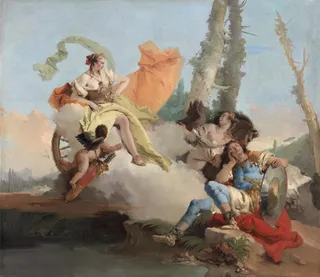 Painted around this timeArmida Encounters the Sleeping Rinaldo
- 1752Würzburg
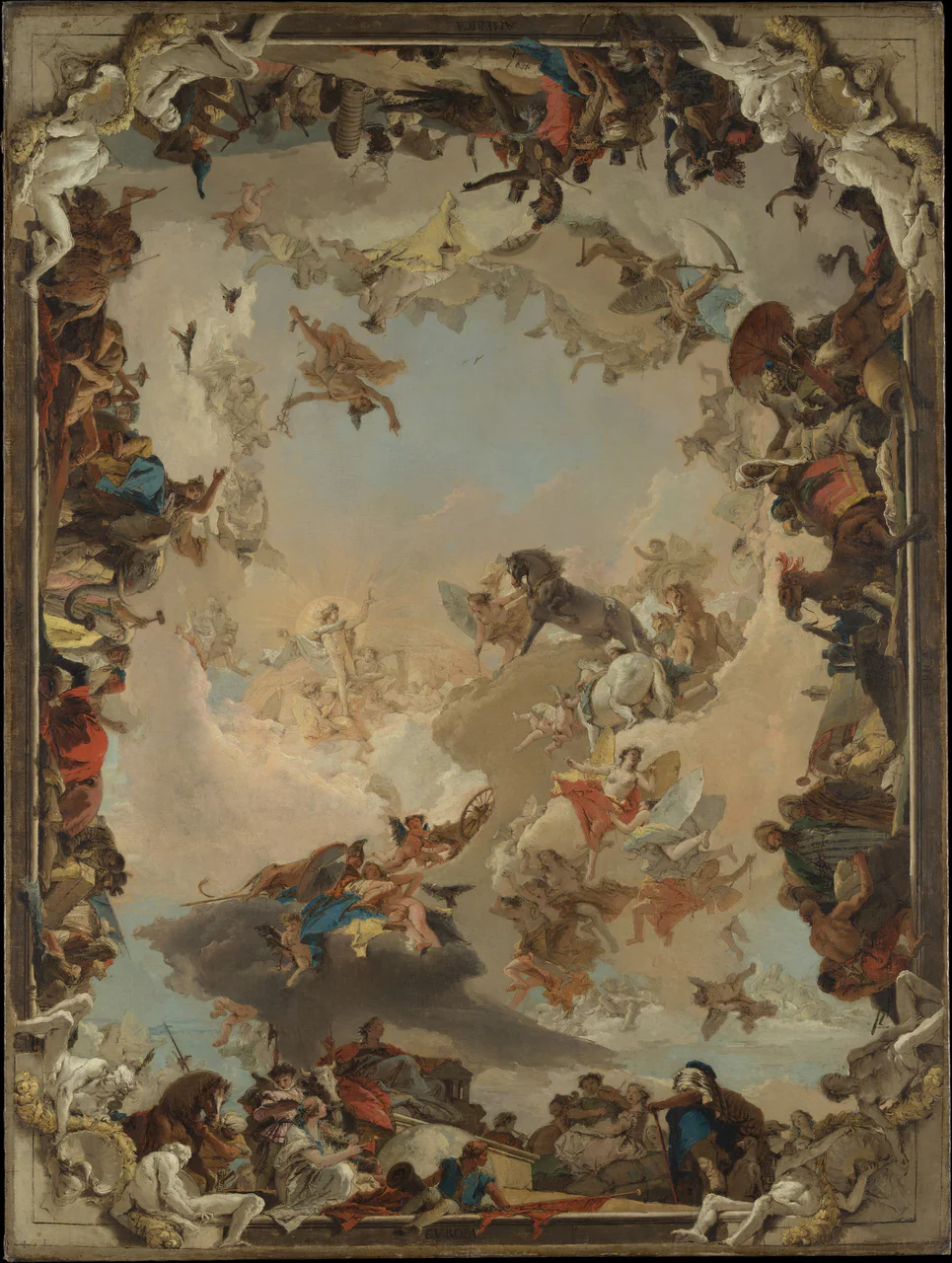
On April 20, 1752, Tiepolo shows an oil sketch to the Prince-Bishop of Würzburg, Karl Philipp von Greiffenclau. It is his plan for the vast ceiling over the new palace staircase, built by the architect Balthasar Neumann.
Apollo floats in the middle of the sketch, and along the four edges spread Europe, Asia, Africa, and America. Tiepolo had arrived in December 1750 with two of his sons. He finished the work and went home to Venice in 1753.
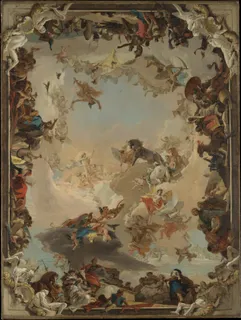 Painted around this timeAllegory of the Planets and Continents
- 1762Madrid
In June 1762, the 66-year-old Tiepolo reaches Madrid with two of his sons. King Charles III has asked him to paint the ceiling of the throne room in the new royal palace. Tiepolo expects to be done in about two years and then head home.
The throne room ceiling grew into a vast celebration of Spain and its lands. But when it was finished, more palace ceilings followed. He never made it back to Venice.
- 1770Madrid
On March 27, 1770, Tiepolo dies suddenly in Madrid, at seventy-four. He had just completed a set of altarpieces for San Pascual, the king's new church at Aranjuez.
Taste at court, though, had already swung toward the calm classical style of the painter Anton Raphael Mengs. Not long afterward Tiepolo's altarpieces were taken down, and paintings by Mengs, Francisco Bayeu, and Mariano Maella went up in their place. One of the removed pictures, The Immaculate Conception, now hangs in the Prado.
People around them
- Cecilia Guardihis wife from 1719, sister of the painter Francesco Guardi.
- Giovanni Domenico Tiepolohis son, who painted beside him in Würzburg and Madrid.
- Lorenzo Tiepolohis son, who went with him to Würzburg and Madrid.
- Francesco Algarottithe writer and collector who bought The Banquet of Cleopatra for the Saxon court.
- Karl Philipp von Greiffenclauthe prince-bishop who commissioned the Würzburg ceilings.
- Charles IIIthe king of Spain who brought him to Madrid.
Works