Pyeongye
Painters · 18th century
Giovanni Domenico Tiepolo
1727–1804
A Venetian painter who spent his youth helping his famous father cover palace ceilings in Germany and Spain, and his old age drawing more than a hundred scenes from the life of the white-clad clown Punchinello.
Scenes from a life
The life of Giovanni Domenico Tiepolo,
scene by scene
- 1747Venice
At twenty, Domenico takes on a job of his own in Venice: fourteen paintings of the Stations of the Cross for the Oratory of the Crucifix at the church of San Polo. Christ's walk to Calvary, scene by scene. He had grown up in the busy workshop of his father, Giovanni Battista Tiepolo, and this was his first big independent commission.
He then etched the pictures himself and published them as prints, a set of sixteen sheets made between 1747 and 1749. Painting ran in the family on both sides. His mother, Cecilia, was the sister of the painters Francesco and Gianantonio Guardi.
- 1750Würzburg
In December 1750 the Tiepolos arrive in Würzburg, in Germany. Domenico's younger brother Lorenzo comes too. The prince-bishop, Carl Philipp von Greiffenclau, wanted them to paint the rooms and the great staircase of his new palace.
For three years the father painted the vast staircase ceiling, with Domenico helping and making pictures of his own. In the corner showing Europe, the father painted his own face. Right beside it he painted Domenico's. The family returned to Venice in 1753.
- 1757Vicenza
At the Villa Valmarana on a hill outside Vicenza, father and son work side by side again, hired by the owner, Giustino Valmarana. The father filled the main house with heroes from old epic poems. Domenico took the guesthouse.
His rooms look nothing like his father's. A peasant family eats at a table. Three farmhands stand with their backs to us. A Chinese merchant shows off his cloth. That same year the father bought a country house for the family at Zianigo, near Venice.
- 1762Madrid
King Charles III of Spain sends for the Tiepolos. He wants the ceilings of his new royal palace in Madrid painted. In 1762 the father, Domenico and Lorenzo pack up once more and set out for Spain.
Over the throne room spread a huge ceiling in praise of the Spanish monarchy. Domenico worked mostly as his father's assistant there, but he also had real room to work on his own. The Spanish years would last eight years.
- 1770Madrid
On March 27, 1770, Giovanni Battista dies suddenly in Madrid, at seventy-four. Domenico leaves Lorenzo behind in Spain and goes home to Venice. Lorenzo never came back.
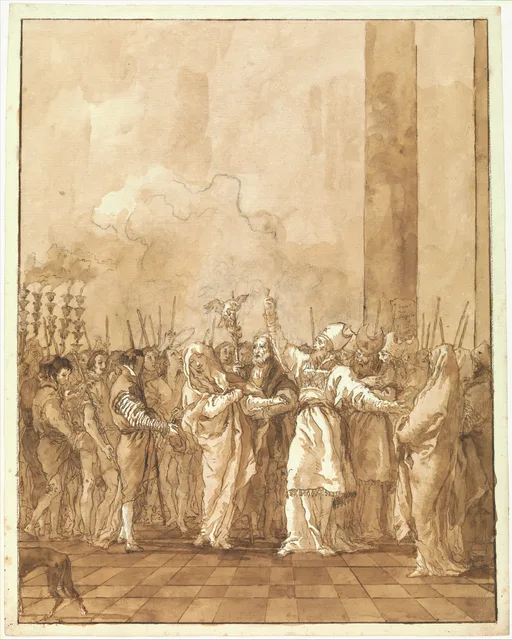
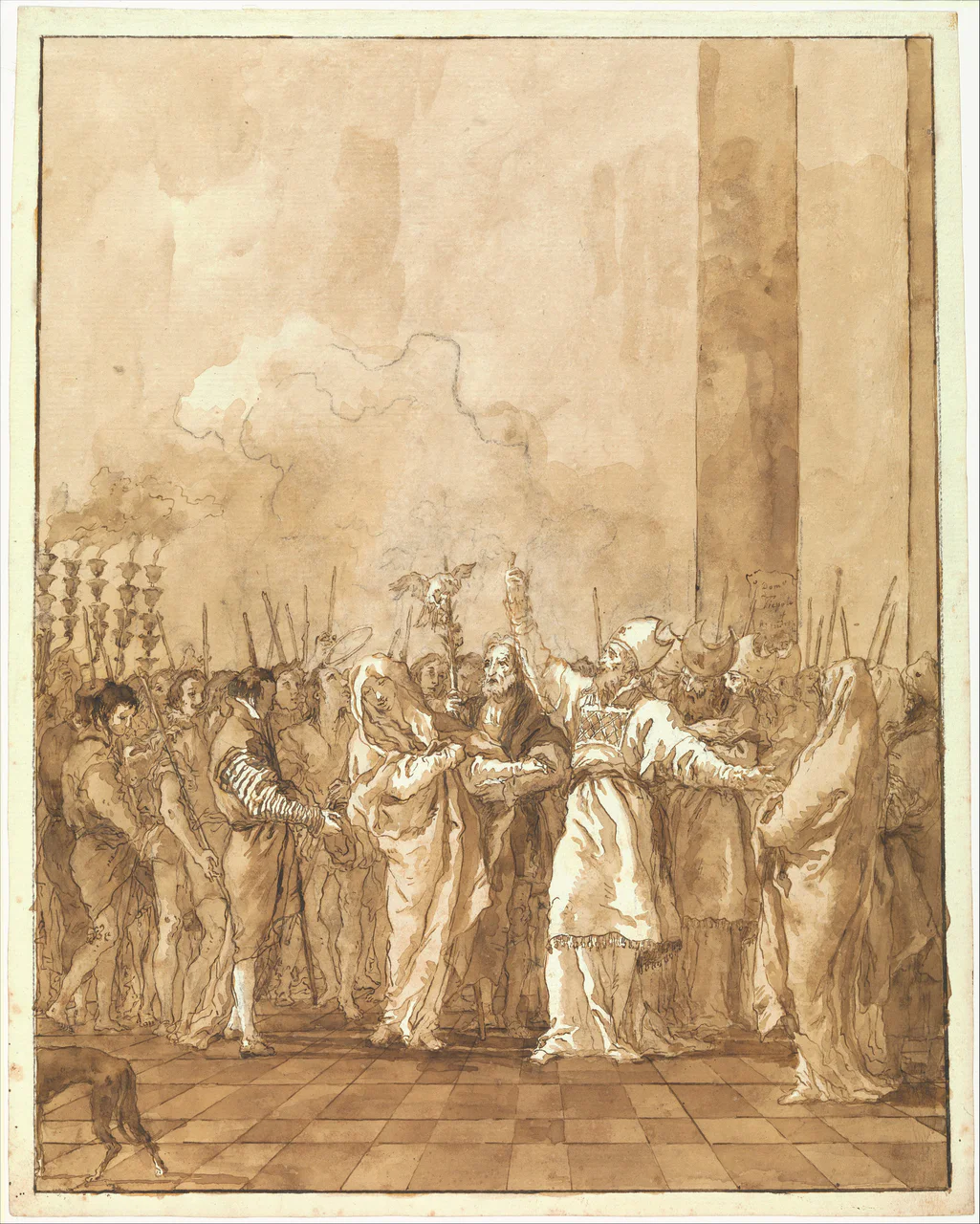
The Betrothal of the Virgin is a drawing from around this time. Above the joined hands of Mary and Joseph rises a staff with a dove perched on top. In the lower left corner, a dog stands with its tail hanging down, paying no attention to the ceremony at all.
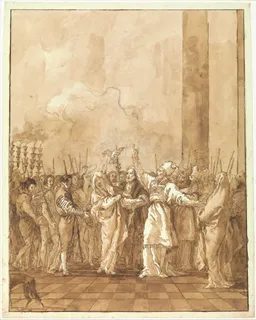 Painted around this timeThe Betrothal of the Virgin
- 1797Zianigo
In 1797 the Republic of Venice, more than a thousand years old, falls to Napoleon. By then Domenico was spending long stretches at the family house in Zianigo. Since 1759 he had been painting its walls, a little at a time.
In one room he painted a crowd seen from behind, gathered to peer into a traveling peep-show box, and dated it 1791. In another, white-clad Punchinellos swing on a swing and tumble like acrobats. Early in the twentieth century the frescoes were cut from the walls to be sold abroad, but in the end the city of Venice bought them. They are now in the Ca' Rezzonico museum.
- 1804Venice
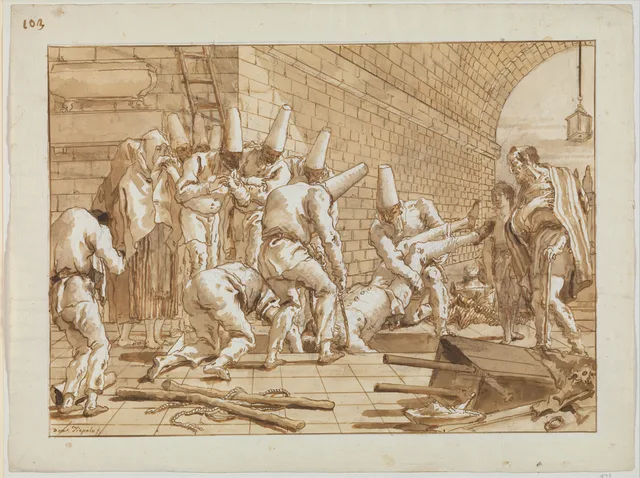
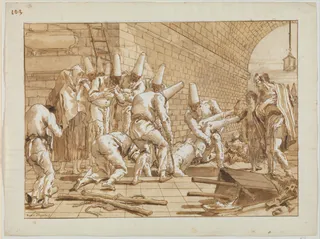
In his last years Domenico followed Punchinello on paper too. In 104 drawings he traced the clown's whole life, from birth and childhood to work, marriage, illness and death. In The Burial of Punchinello, men in tall hats lower their friend into a grave with ropes, while others hide their faces and weep. A skull lies on the floor at lower right.
Domenico died in Venice on March 3, 1804. The 104 sheets stayed together for more than a century, until a London sale in 1920 scattered them. This one passed to the New York collector Robert Lehman and came to the Metropolitan Museum in 1975.
Painted around this timeThe Burial of Punchinello
People around them
- Giovanni Battista Tiepolohis father and teacher, with whom he painted ceilings in Würzburg and Madrid.
- Lorenzo Tiepolohis younger brother, who went with them to Würzburg and Madrid and stayed in Spain.
- Cecilia Guardihis mother, sister of the painter Francesco Guardi.
- Carl Philipp von Greiffenclauthe prince-bishop who brought the Tiepolos to Würzburg.
- Charles IIIthe king of Spain who called them to Madrid.
Works