Pyeongye
Painters · 18th century
Francesco Guardi
1712–1793
A Venetian who spent decades painting figures in his older brother's workshop, then, past the age of forty, turned to the water, sky and gondolas of his city with quick, flickering strokes.
Scenes from a life
The life of Francesco Guardi,
scene by scene
- 1719Venice
In 1719 there is a wedding in a family of Venetian painters. Cecilia Guardi marries a young artist named Giovanni Battista Tiepolo. Her little brother Francesco is still a child.
Their father, Domenico, had died in 1716. The eldest son, Gian Antonio, took over the family workshop and trained his younger brothers, Francesco and Niccolò. Tiepolo, who would become famous for his ceiling paintings, was now Francesco's brother-in-law.
- 1730Venice
Around 1730, Field Marshal Johann Matthias von der Schulenburg, a German commander in Venetian service, takes Gian Antonio on as his house painter. The marshal was a serious collector. Much of Gian Antonio's work for him was copying paintings by old masters such as Titian and Tintoretto.
The arrangement lasted into the mid-1740s. Francesco, too, worked in his brother's shop as a figure painter. Because the brothers often worked on the same commissions, scholars still argue over which of them painted what.
- 1757Venice
On February 15, 1757, Francesco, forty-four, gets married. His bride, Maria Mattea Pagani, was the daughter of the painter Matteo Pagani. Their son Giacomo was born in 1764 and would grow up to carry on his father's work.
In 1760 Gian Antonio died. With his older brother gone, Francesco moved more and more into painting vedute, views of Venice itself.
- 1764Venice
On April 25, 1764, the Venetian diarist Pietro Gradenigo opens his diary. Writing about views Guardi had put on show, he called him a good pupil of the famous Canaletto.
There is no record that Guardi actually studied with Canaletto. But the diary entry is early evidence that, at fifty-one, Guardi was starting to be noticed as a painter of Venetian views.
- 1770sVenice
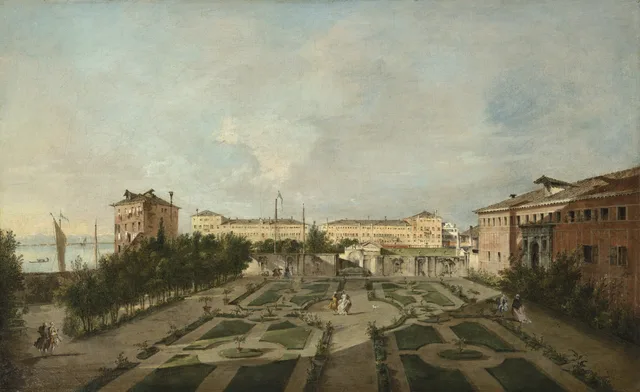
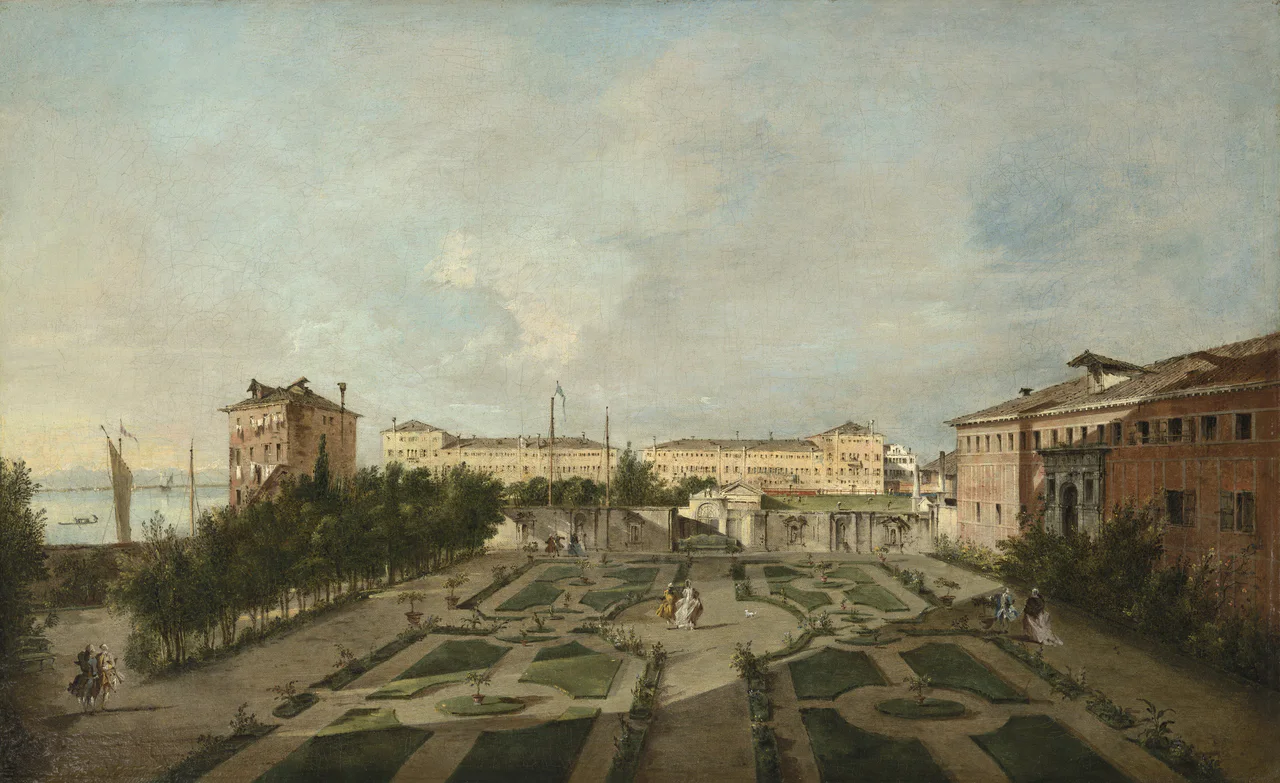
In the late 1770s, John Strange, the British diplomatic representative in Venice, orders a set of four paintings from Guardi. According to the Art Institute of Chicago, two of them showed Strange's own villa on the mainland. The Garden of Palazzo Contarini dal Zaffo was part of the set.
Look at the painting. A red-walled palace stands at right, and a formal garden of geometric flower beds spreads in front of it. In the middle, two figures in pale clothes stroll side by side with a small white dog. Beyond the trees at far left, you can see the lagoon and a sailboat.
 Painted around this timeThe Garden of Palazzo Contarini dal Zaffo
- 1782Venice
In January 1782, a Russian grand duke and duchess arrive in Venice, traveling as the Count and Countess of the North. The Venetian government hired Guardi to record the festivities held in their honor. When Pope Pius VI visited that May, Guardi painted a series of scenes from that visit too.
Two years later, in 1784, Guardi was finally elected to the Venetian Academy. Even then, he was admitted not as a figure painter but as a painter of perspective views.
- 1789Venice
In 1789, fire breaks out at an oil depot near San Marcuola in the Cannaregio district. Guardi painted the scene of the disaster. The version now in the Alte Pinakothek in Munich is counted among the last paintings of the aging artist.
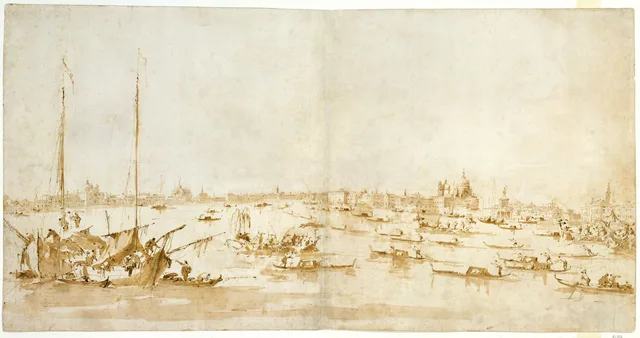
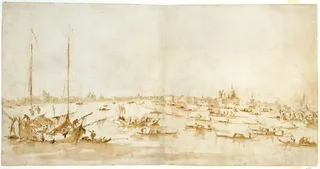
In these late years he also made long drawings like Panoramic View of the Bacino di San Marco, Looking up the Giudecca Canal. Two big boats with half-furled sails stand at left. Gondolas with cabins glide across the water to the right, and far off a domed church rises in thin lines of brown ink.
Painted around this timePanaromic View of the Bacino di San Marco, Looking up the Giudecca Canal - 1793Venice
On January 1, 1793, Guardi dies in Venice at eighty. His son Giacomo went on painting Venetian views in his father's manner and selling them to visitors.
Four years later, in 1797, the Republic of Venice, which had lasted more than a thousand years, fell to Napoleon. Guardi's brush had caught its last years as light on water. Those works now hang at the Metropolitan Museum of Art and the Art Institute of Chicago.
People around them
- Gian Antonio GuardiHis older brother, who ran the family workshop after their father died and trained him.
- Giovanni Battista TiepoloHis brother-in-law, who married his sister Cecilia in 1719.
- Maria Mattea PaganiHis wife from 1757, daughter of the painter Matteo Pagani.
- Giacomo GuardiHis son, who carried on painting views in his father's style.
- John StrangeThe British representative in Venice who ordered a set of garden and villa views.
Works