Pyeongye


Painters · 17th century
Claude Lorrain
1604–1682
A painter from Lorraine who spent his life in Rome, filling the seas and hills of old stories with low, golden light.
Scenes from a life
The life of Claude Lorrain,
scene by scene
- 1604–05Chamagne, Lorraine
In Chamagne, a small village in the Duchy of Lorraine, a boy named Claude Gellée was born. The name we know him by, Lorrain, simply means the man from Lorraine. His birth year was long given as 1600, but most scholars now put it at 1604 or 1605.
The Florentine writer Filippo Baldinucci recorded that Claude lost his parents when he was about twelve. The boy went to Freiburg, in German lands, to stay with his brother Jean, a woodcarver. His training as a painter began later, south of the Alps.
- 1625Nancy
Claude came home to Lorraine after his first years in Italy, where he had studied in Naples and in Rome. In Rome he is generally thought to have worked in the studio of the landscape painter Agostino Tassi. In Nancy he became an assistant to Claude Deruet, the court painter of Lorraine, and helped him paint church frescoes. Those frescoes no longer survive.
The job at home did not last. In 1627 Claude went back to Rome. He lived there for the rest of his life.
- 1630sTivoli
A German painter in Rome, Joachim von Sandrart, became Claude's friend. Years later, in his book the Teutsche Academie, Sandrart wrote that he, Poussin, and Claude rode out to Tivoli together to draw and paint the landscape from life.
He also wrote that Claude lay in the fields from before dawn until night, studying nature. According to Sandrart, Claude even painted oil sketches outdoors. No such outdoor oil sketch has been identified today. Have you ever watched a sunrise from start to finish?
- 1635–36Rome
As Claude's name spread, a problem appeared. Pictures in his style began to circulate as his own work. From around this time, each time he finished a painting, he made a drawing of it and kept the drawings together in one book. That book is the Liber Veritatis, the Book of Truth.
Baldinucci wrote that the book was meant to stop other people's pictures from being sold as Claude's. In the same decade, King Philip IV of Spain ordered landscapes from painters in Rome to decorate the Buen Retiro palace in Madrid. Claude was one of them, and those paintings are now in the Prado.
- 1643Rome
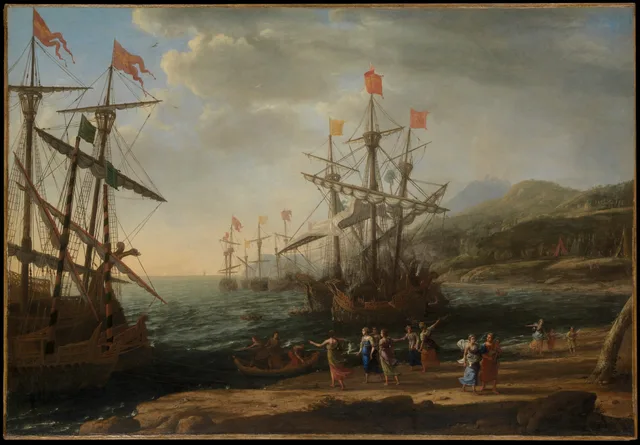
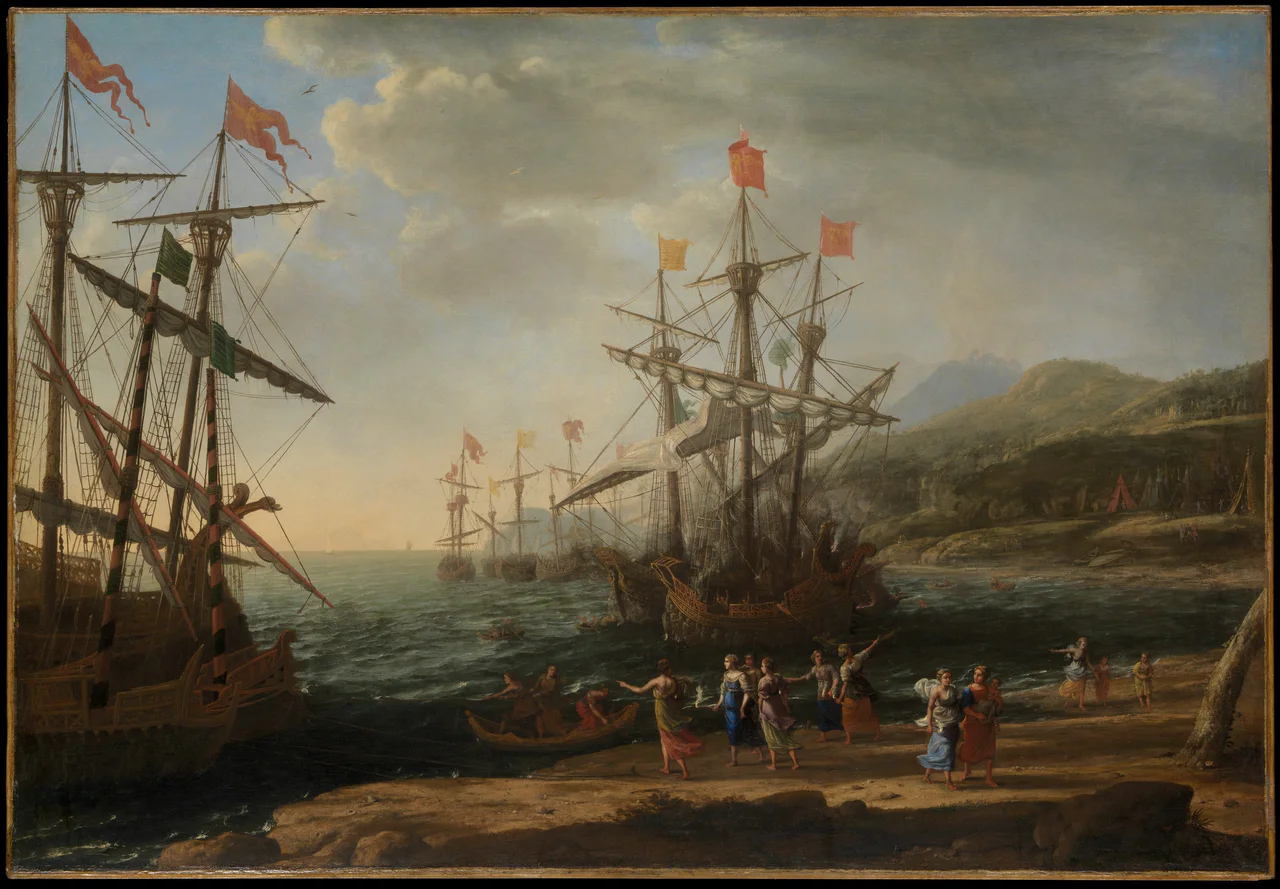
Girolamo Farnese, a churchman who had spent years as the pope's envoy in what is now Switzerland, came back to Rome. He ordered a painting from Claude. The story was from Virgil's Aeneid: Trojan women, worn out by years of wandering, set fire to their own ships.
Claude drew the finished picture in his Book of Truth and noted that he had painted it in Rome for Farnese. That note is how we know who first owned The Trojan Women Setting Fire to Their Fleet. Women run across the sand, yet most of the canvas belongs to the wide sea and sky.
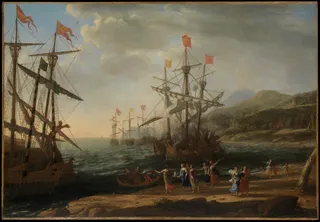 Painted around this timeThe Trojan Women Setting Fire to Their Fleet
- 1663Rome
Claude had long suffered from gout, and this year he fell seriously ill. He was sick enough to draw up a will. He recovered, and went on painting for almost twenty more years.
Claude never married, but his house was not empty. Agnese, who is believed to have been his daughter, grew up there. From about this time his nephew Jean, who came from Lorraine, lived with him too.
- 1673Rome
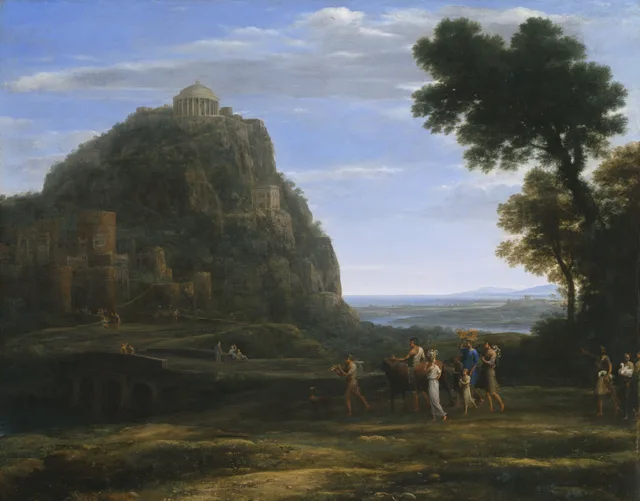
Camillo Massimi, made a cardinal a few years earlier, ordered a painting from Claude. Massimi was a learned collector and a patron of Poussin. The result was View of Delphi with a Procession. A preparatory drawing Claude made for it carries a note saying the scene follows the description of Delphi by the ancient historian Justinus.
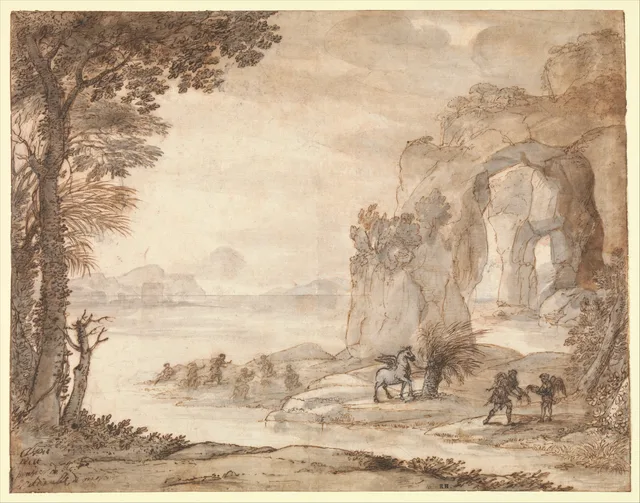
In the painting, a round temple crowns a rocky hill on the left. Lower right, a procession walks past: a man leading an ox, another blowing a horn, someone carrying something on their head. Massimi also ordered the story of Perseus and the origin of coral, and after many drawings Claude finished that painting in 1674.
Painted around this timeView of Delphi with a Procession - 1682Rome
In November 1682 Claude died in Rome. He was buried in the church of Trinità dei Monti. Much later, in 1840, his remains were moved to San Luigi dei Francesi, the French church in Rome.
The Book of Truth went to England, where the Dukes of Devonshire kept it for a long time, and it entered the British Museum in 1957. The paintings scattered too. View of Delphi with a Procession came to the Art Institute of Chicago in 1941, and The Trojan Women Setting Fire to Their Fleet came to the Metropolitan Museum in 1955. The drawing Perseus and the Origin of Coral arrived at the Met in 1975 with Robert Lehman's collection.
People around them
- Agostino Tassithe landscape painter in whose Roman studio Claude is thought to have trained.
- Claude Deruetcourt painter of Lorraine, who took Claude on as an assistant in Nancy.
- Joachim von Sandrarta German painter who sketched with Claude in Rome and later wrote about him.
- Nicolas Poussina French painter living in Rome who rode to Tivoli with Claude and Sandrart.
- Camillo Massimithe cardinal who ordered View of Delphi with a Procession and the Perseus painting.
- Agnesebelieved to be Claude's daughter, she lived in his house.
Works