Pyeongye

Painters · 18th century
Thomas Gainsborough
1727–1788
A boy from a Suffolk wool town who became painter to a king and queen, yet kept coming back to country lanes, woods, and barefoot children.
Scenes from a life
The life of Thomas Gainsborough,
scene by scene
- 1740Sudbury to London
A thirteen-year-old boy talks his father into it. He wants to go to London and learn to draw. The father, John Gainsborough, made his living in the wool cloth trade in Sudbury, Suffolk, and Thomas was one of nine children. Around 1740 the boy got his way.
In London he worked alongside Hubert-François Gravelot, a French engraver who had settled in the city. Few papers survive from these years. But a boy who had sketched trees and hedges at home now spent his days in a busy print workshop, learning to make a fine, careful line.
- 1746London
In July 1746, nineteen-year-old Gainsborough married Margaret Burr in a small chapel in Mayfair. Margaret came with an income of 200 pounds a year, paid by the Duke of Beaufort. People long whispered that she was the duke's daughter, born outside marriage.
For a young painter, that money was a lifeline. The couple soon moved back to Suffolk, and in 1752 they settled in the port town of Ipswich. Their two daughters, Mary and Margaret, grew up there.
- 1759Bath
Philip Thicknesse, an officer at Landguard Fort near Ipswich, took an interest in the young painter. He ordered a view of the fort, and he pushed Gainsborough to try his luck in Bath. In 1759 the family moved to the spa town. Wealthy visitors came there to rest and be seen, and sitters soon lined up at his door.
In 1760 he painted the musician Ann Ford, who later married Thicknesse. Gainsborough loved music himself and played the viola da gamba. Thicknesse outlived his friend and published the first life of the painter in 1788.
- 1774Pall Mall, London
When the Royal Academy was founded in London in 1768, Gainsborough, still living in Bath, was named one of its founding members. In 1774 he finally moved his family to London. They took part of Schomberg House, a large mansion on Pall Mall.
He lived on that street for the rest of his life. From then on he and Joshua Reynolds, the president of the Academy, were rivals for the richest portrait sitters in town.
- 1782Windsor
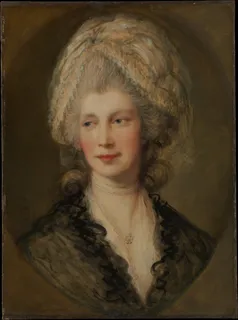
In September 1782 Gainsborough went to Windsor Castle to paint the royal family. One by one he painted King George III, Queen Charlotte, and thirteen of their children: fifteen small oval heads in all. The next year they hung together at the Royal Academy. Only a year before, he had shown full-length portraits of the king and queen there.
The Met's Queen Charlotte is a second version the painter made himself of the queen's Windsor portrait. Look at the tall powdered hair under a lace cap. A string of pearls circles her throat, and black lace falls over her shoulders. She glances to one side with the faintest smile.
 Painted around this timeQueen Charlotte
- 1783The Lake District
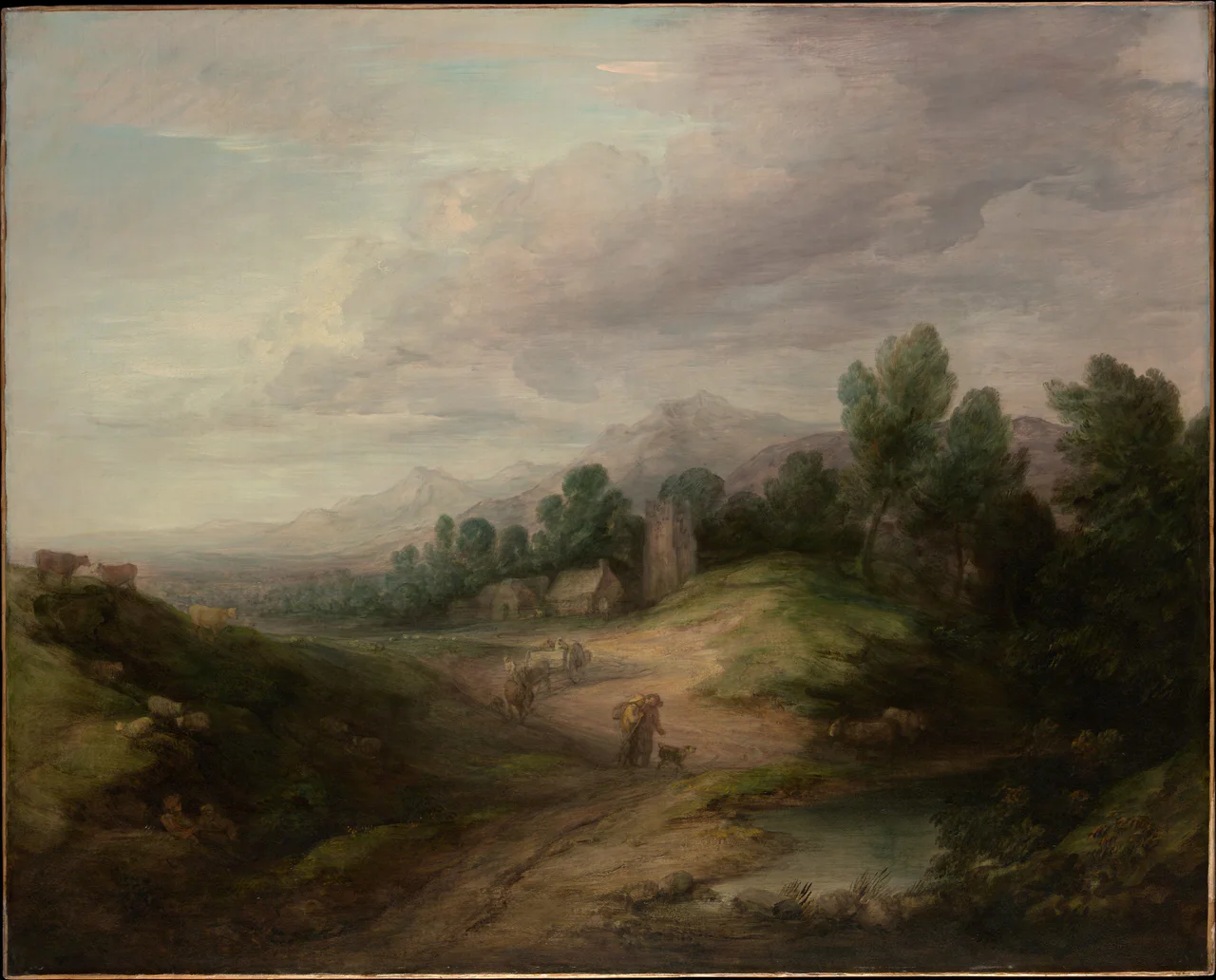
In 1783 Gainsborough set off for the Lake District in the north of England with an old friend from his Ipswich days, Samuel Kilderbee. Steep fells and long lakes were new country for him. After the trip, mountains rose more often in his landscapes.
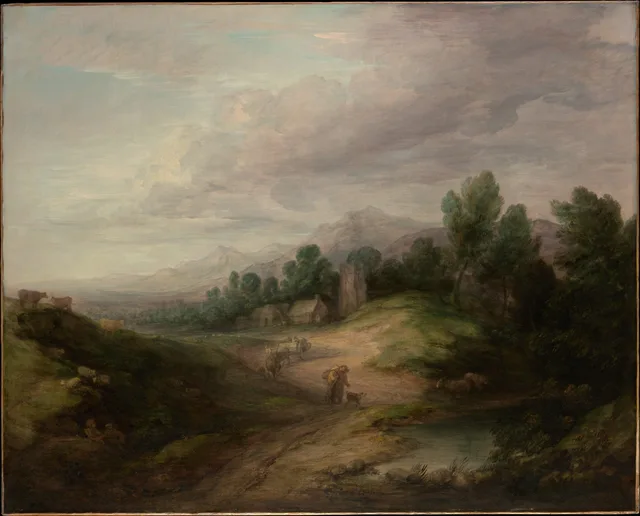
Wooded Upland Landscape probably dates from this year. Reynolds later said Gainsborough built little model landscapes on his table out of broken stones, dried plants, and bits of mirror. Find the road in the middle: a figure with a load on their back walks with a dog. Behind them stand cottages, an old tower, and layer after layer of far hills.
 Painted around this timeWooded Upland Landscape
- 1784Pall Mall, London
Before the Academy show, Gainsborough wrote to the men hanging the pictures. He asked them to hang his portrait of three princesses low, no higher than five and a half feet from the floor.
The Academy wanted it up above the line, the way such pictures were usually hung. So Gainsborough took it back, along with every other picture he had sent that year. He never showed at the Academy again. Instead he opened his own rooms at Schomberg House and showed his work to visitors there.
- 1788London and Kew
In 1788 a swelling on Gainsborough's neck turned out to be cancer. As he grew weaker, he asked for his old rival Reynolds, and Reynolds came to see him.
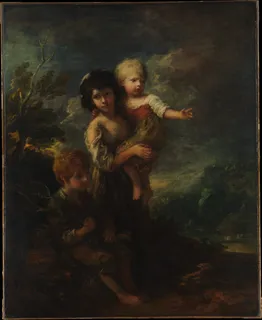
Gainsborough died on August 2, 1788, at sixty-one. He was buried in the churchyard at Kew, beside his old friend Joshua Kirby. That December, Reynolds gave an Academy lecture that spoke at length in his honor. Now look at the girl in Cottage Children, painted the year before, in 1787. Holding a small child in her arms, she looks straight out at us from a big canvas.
 Painted around this timeCottage Children (The Wood Gatherers)
People around them
- Margaret Burrhis wife from 1746, whose yearly income kept the young family afloat.
- Hubert-François Gravelotthe French engraver in London beside whom the teenage Gainsborough learned his trade.
- Philip Thicknessethe fort officer who steered him to Bath and later wrote the first account of his life.
- Samuel Kilderbeea friend from Ipswich who traveled with him to the Lake District in 1783.
- Joshua Reynoldspresident of the Royal Academy and his long rival, who came to say goodbye.
- Joshua Kirbya friend from his Suffolk years, beside whom he was buried at Kew.
Works