Pyeongye
Painters · 18th century
Jean Honoré Fragonard
1732–1806
Born in Grasse in the south of France, Fragonard painted love stories, overgrown gardens and lightning-fast portraits in Paris, and in the years of the Revolution he helped run the new museum at the Louvre.
Scenes from a life
The life of Jean Honoré Fragonard,
scene by scene
- 1752Paris
A twenty-year-old enters the Prix de Rome, the Royal Academy's competition that sent young painters to study in Rome at the crown's expense. There was a catch. Fragonard was not an official student of the Academy. His teacher, François Boucher, urged him to compete anyway.
He won first prize with Jeroboam Sacrificing to the Idols. Before Boucher he had spent a short time in the studio of Jean-Siméon Chardin. After the prize came three more years at the royal school for prize-winners, run by Carle Van Loo, and in 1756 he finally left for Rome.
- 1760Tivoli
In July and August, Fragonard spends several weeks at the Villa d'Este, in the hill town of Tivoli east of Rome. His host is the Abbé de Saint-Non, a wealthy amateur who drew and made prints himself. The villa's gardens were overgrown, full of fountains, stairways and towering cypresses.
Fragonard filled sheet after sheet with red chalk views of them. In Rome he also went out sketching ruins and countryside with Hubert Robert, a painter one year younger. In 1761 he travelled back to Paris with Saint-Non, touring the cities of northern Italy on the way.
- 1765Paris
On 30 March, a single huge canvas wins Fragonard provisional membership of the Royal Academy. It is Coresus Sacrificing Himself to Save Callirhoe, an ancient tale of love and sacrifice, about four meters wide. In August it hung at the Salon and caused a sensation.
The king bought it as a model for a tapestry to be woven at the Gobelins workshops. The critic Denis Diderot wrote about it at great length, framing his review as a dream set in Plato's cave. Yet after this triumph Fragonard largely turned away from the grand history painting the Academy prized most.
- 1767Paris
In October, the playwright Charles Collé writes a strange story in his journal. A courtier wanted a picture of his mistress on a swing. He first asked the painter Gabriel-François Doyen, fresh from success at that year's Salon. Doyen said no, and by the time Collé wrote, Fragonard was already at work on the commission. That picture is usually identified as The Swing, now in the Wallace Collection in London.
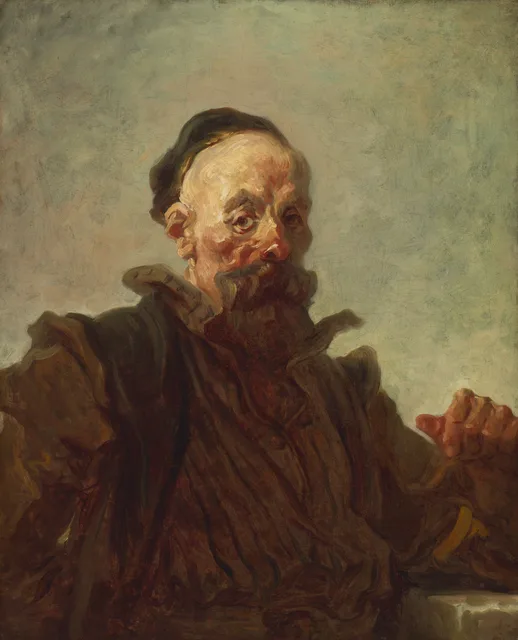
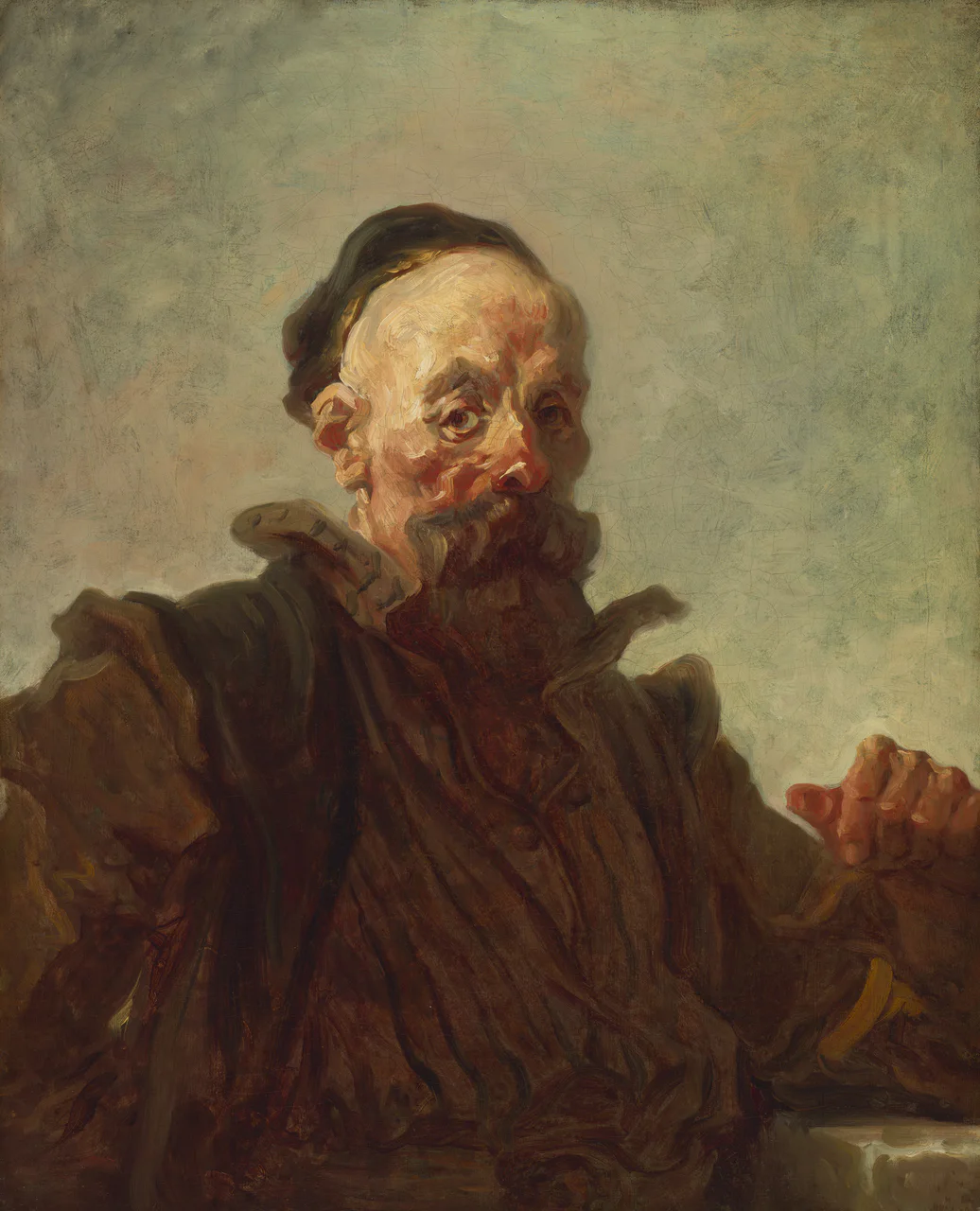
Around the same time he dashed off bold half-length figures like Portrait of a Man in Costume. The man wears a black cap, and his beard juts out over a wide collar. On the right he raises a reddish hand. On his forehead the cream paint sits so thick you can follow every stroke.
 Painted around this timePortrait of a Man in Costume
- 1769Paris
On 17 June, Fragonard, then thirty-seven, marries Marie-Anne Gérard. She came from his hometown of Grasse, the daughter of a perfume distiller, and she painted too. Their daughter Rosalie was born that year. Some years later Marie-Anne's younger sister, Marguerite Gérard, joined the household in Paris, studying with her brother-in-law and working at his side.
In these years he painted people he knew in old-fashioned costume, at top speed. In Marie Emilie Coignet de Courson with a Dog, the sitter wears pearls wound through her piled-up hair. She holds a small white dog high and glances sideways at us. The dog's blue ribbon tumbles all the way to the bottom of the canvas.
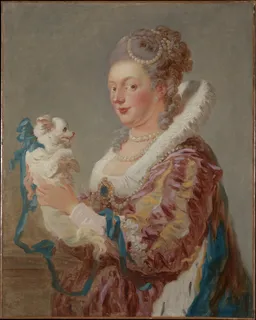 Painted around this timeMarie Emilie Coignet de Courson (1716–1806) with a Dog
- 1773Louveciennes and Italy
In 1773, Madame du Barry, the favorite of Louis XV, sends back four large canvases. She had ordered them from Fragonard for her new pavilion at Louveciennes, a series about young lovers. She replaced them with paintings in the new classical style by Joseph-Marie Vien. Why she rejected them is still unknown.
That October, Fragonard and his wife set off for Italy again with the rich tax farmer Bergeret de Grancourt. The trip took them to Rome and Naples and lasted almost a year, and Bergeret kept a travel diary. On the way home the two men quarrelled over who owned the drawings Fragonard had made on the journey, and the dispute ended up in court.
- 1790Grasse
The year after the Revolution began, Fragonard takes his family south to Grasse. In his luggage are the four canvases Madame du Barry had returned. He had kept them, unsold, for nearly twenty years. Two years earlier, in 1788, his daughter Rosalie had died at eighteen.
In Grasse he hung the four paintings in the salon of his cousin Alexandre Maubert's house, then spent a year painting ten more to fill the room. They stayed with the family for over a century, were sold in 1898, and were bought in 1915 by the New York collector Henry Clay Frick. Today they fill the Fragonard Room at the Frick Collection.
- 1806Paris
Back in Paris, Fragonard found help from Jacques-Louis David, the leading painter of the Revolution. Through David he got lodgings in the Louvre and an administrative post at the new national museum there. It was the moment the Louvre was first becoming a public museum.
In 1806 he had to leave his Louvre lodgings. On 22 August that year he died in Paris, aged seventy-four, and his death passed almost unnoticed. Two of his quick, vivid half-length portraits now hang in the Art Institute of Chicago and the Metropolitan Museum of Art in New York.
People around them
- François Boucherhis teacher, who urged him to enter the Prix de Rome though he was not an Academy student.
- Hubert Roberta painter he sketched ruins and fields with in Rome, and a close friend.
- Abbé de Saint-Nonthe patron who brought him to the Villa d'Este at Tivoli in the summer of 1760.
- Marie-Anne Gérardhis wife from 1769, from Grasse, and a painter herself.
- Marguerite Gérardhis wife's younger sister, who trained with him in Paris and became a painter.
- Jacques-Louis Davidthe painter who helped him find lodgings and a museum post at the Louvre during the Revolution.
Works