 Pyeongye
Artwork · 19th century · Georges Seurat
LeoTurn on Magnifier at the lower right and move slowly across the painting.
Full screen opens it edge to edge.Tap the painting to fill the screen.
Spread two fingers to look closer.
At a glance
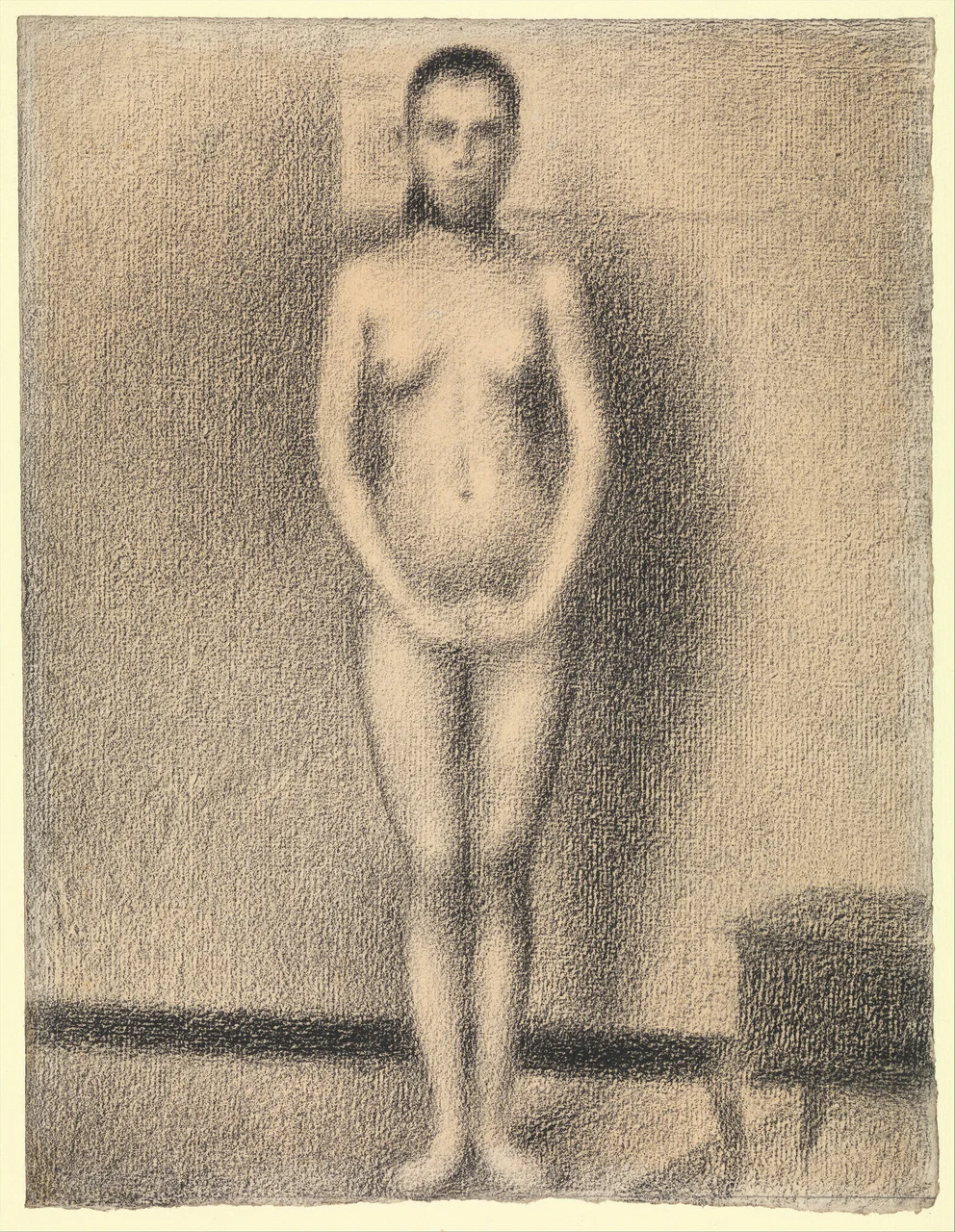
- A nude model stands straight in front of a studio wall, arms down, looking right at us.
- Georges Seurat drew this study in Conté crayon in 1886–87.
- There is not a single outline, yet the body rises out of the paper through light and dark alone.
Reading the picture
4 places to look closer
Tap a number on the painting to jump to its note, or a close-up to see that spot in the whole picture.
Zoom in on the face. No lines mark the eyes, nose, or mouth. Seurat pressed black crayon into the eye sockets and the hair and left the forehead and cheeks the color of the paper. Step back, and a calm face looks straight at you.
Look at the arm on the right side of the picture. It floats as a pale strip, with deep shadow laid on both sides of it. Instead of drawing a line between the body and the wall, Seurat put dark next to light and let the shape appear.
Now look very closely at the empty wall on the left. What reads as gray from a distance is really a scatter of black grains and paper-colored grains. The crayon caught only on the raised bumps of the textured paper. It looks a lot like the tiny dots of color in Seurat's paintings.
Find the dark mass in the lower right corner. Seurat built a boxy object out of dense vertical strokes. To its left, a black band runs across the sheet where the floor meets the wall. With just these two things, the empty room gains depth.
When it was painted
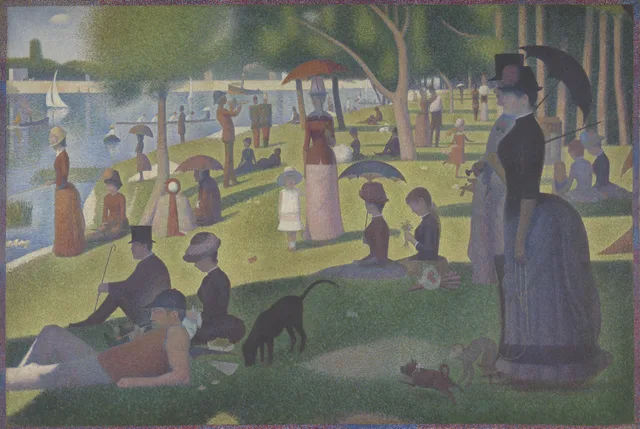
In May 1886, Georges Seurat, then twenty-six, hung a canvas more than ten feet wide at the eighth and last Impressionist exhibition in Paris. A Sunday on La Grande Jatte was built from countless small dots of color set side by side. Visitors were split: some were fascinated, others baffled. That same year the critic Félix Fénéon gave Seurat and the painters who followed his method a name, the Neo-Impressionists.
Not all the attention was kind. Some critics said the dotted figures in La Grande Jatte looked stiff and lifeless. For his next big picture, Seurat moved indoors, into his own studio. The Models (Les Poseuses) shows three nude women, one seen from the front, one from behind, and one in profile, with a corner of La Grande Jatte hanging on the wall at the left.
Many scholars read the painting as Seurat's answer to those critics, proof that his dots could handle the human body. This drawing prepares the woman who stands at the center, the only one of the three who looks straight out at us. Seurat also painted a small oil sketch on a wood panel for each of the three models. Those three panels are now in the Musée d'Orsay in Paris.
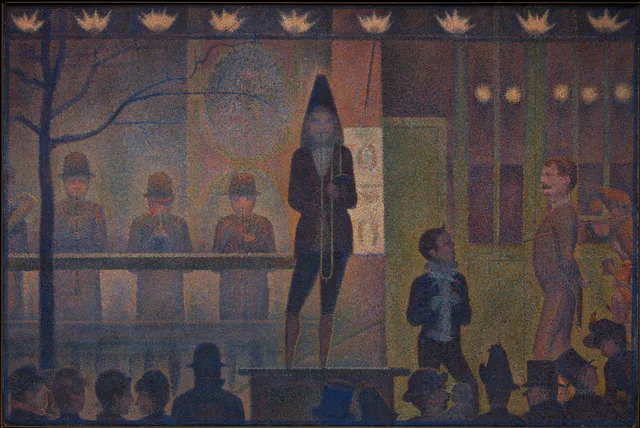
The Models went on view at the Salon des Indépendants in the spring of 1888. Seurat pressed on with more large canvases, including Circus Sideshow and Le Chahut. Then, in March 1891, he died suddenly at thirty-one. The Models now hangs at the Barnes Foundation in Philadelphia, and this sheet came to The Met in 1975 with the Robert Lehman Collection.
Look at her again. In the finished painting, discarded clothes, hats, and two other models crowd around her. Here she stands alone against a bare wall, hands folded in front of her.
Questions to think about
- Look for itThere are no outlines anywhere. Can you still find exactly where the model's legs end and the wall begins?
- Why?Why do you think Seurat had his model stand stiffly upright instead of striking a graceful pose?
- What about you?Artists' models were usually paid to hold one pose for long stretches of time. Only the artist's name stays on the work. How should we remember the people who helped make it?
Same period
Painted around the same time,
somewhere else
Too good to keep to yourself
This painting,
for someone who comes to mind
They open it at full size
and see every brushstroke.
About this work
- Artist
- Georges Seurat · 1859–1891
- Date
- 1886–87
- Medium
- Conté crayon on laid paper.
- Size
- 29.7 × 22.5 cm
- Collection
- The Metropolitan Museum of Art
- Image
- Original long edge 3854px · shown at 2560px
- Original
- View on the museum's website ↗