 Pyeongye
Artwork · 18th century · Francesco Guardi
LeoTurn on Magnifier at the lower right and move slowly across the painting.
Full screen opens it edge to edge.Tap the painting to fill the screen.
Spread two fingers to look closer.
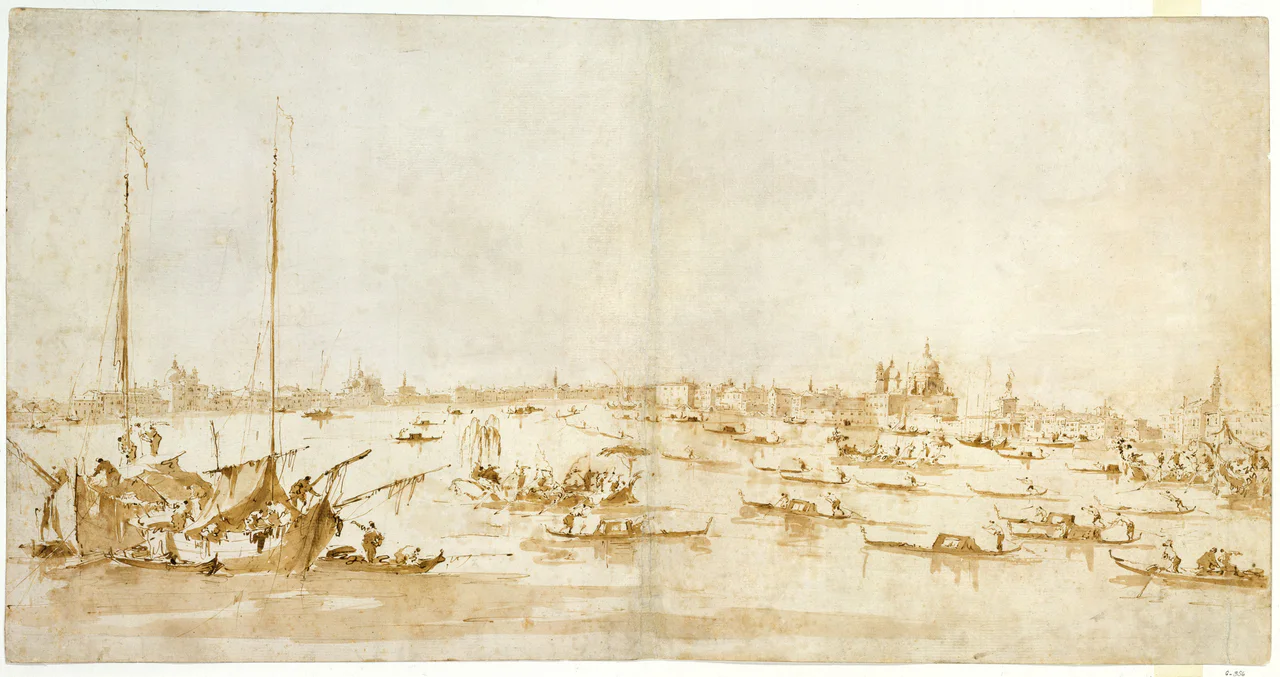
Panaromic View of the Bacino di San Marco, Looking up the Giudecca Canal
Francesco Guardi1780–93Pen and brown ink, light brown wash, on two sheets of paper, joined.34.9 × 67.6 cm
At a glance
- A crowded stretch of water in Venice: gondolas and sailing boats on the Bacino di San Marco, with domes and rooftops lined up toward the Giudecca Canal.
- Francesco Guardi, a Venetian painter, drew it sometime between 1780 and 1793 in pen, brown ink, and a light brown wash.
- He joined two sheets of paper to get a view more than two feet wide, then built a whole city out of quick strokes.
Reading the picture
5 places to look closer
Tap a number on the painting to jump to its note, or a close-up to see that spot in the whole picture.
Zoom in on the big dome rising over the buildings on the right. That is Santa Maria della Salute, the church Venice vowed to build during the plague of 1630. Guardi gives it only a few curved lines and a pale wash. Still, it sits there with real weight.
Now look just to the right of the dome, at the low tower on the point. On top sits a round ball, and on the ball a small figure balances on one foot. This is the customs house of Venice, crowned by a golden globe and a statue of Fortune. The statue turns with the wind like a weather vane.
Drop down to the two big sailing boats at lower left. Their sails hang loose, and people bend over the decks at work. None of them has a face or hands. They are brown blots and a few broken lines, yet you can almost feel them moving.
Zoom in on one gondola at lower right. In the middle is a small cabin with a window, and at the back a boatman stands and rows. Under the boat, Guardi dragged his brush straight down a few times. Those few strokes become the reflection in the water.
Find the thin line that runs straight down the sky in the very middle. It is the seam where two sheets of paper meet.
When it was painted
In the 1780s Guardi was a Venetian painter of around seventy. As a young man he had worked in a family studio run with his older brother, Gian Antonio, painting whatever clients ordered. His sister Cecilia married the painter Giovanni Battista Tiepolo, so Tiepolo was Guardi's brother-in-law.
After Gian Antonio died in 1760, Francesco turned more and more to views of Venice, its water and its buildings. In those days, when people thought of Venetian views, they thought first of Canaletto. Canaletto set down buildings as crisply as if he had used a ruler. Guardi let the light and the water shimmer under quick, flickering strokes. In his lifetime he never enjoyed Canaletto's standing.
Still, late in life some recognition came. When Pope Pius VI visited Venice in 1782, Guardi recorded the visit in a series of paintings. In 1784, past seventy, he was elected to the Venetian Academy of painting.
He died in Venice on the first day of 1793. His son Giacomo went on painting Venetian views in his father's manner. Four years later, in 1797, the Republic of Venice, which had lasted more than a thousand years, fell to Napoleon.
Much later this long sheet belonged to the New York banker Robert Lehman, and it came to the Metropolitan Museum in 1975 with the rest of his collection. Look again at the wet brown strokes on the big sailing boats at the left. In the Republic's last years, the old painter was still catching a day on the water with a hand this fast.
More by the same painter
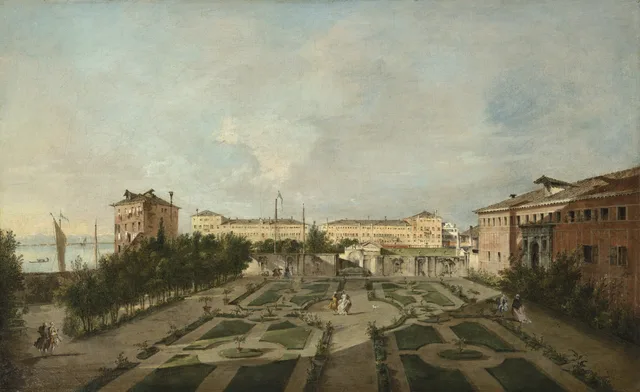
Questions to think about
- Look for itHow many gondolas with a little cabin can you count in the picture?
- Why?Why do you think Guardi left out every face and drew people only as brown blots and lines?
- What about you?Today, visitors carry Venice home in phone photos instead of drawings. If you lived in a city packed with tourists, how would it feel to have your neighborhood turned into someone else's souvenir?
Same period
Painted around the same time,
somewhere else
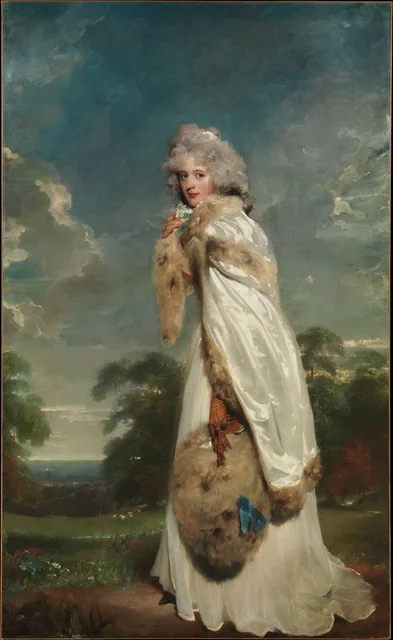 Elizabeth Farren (born about 1759, died 1829), Later Countess of DerbySir Thomas Lawrence1790
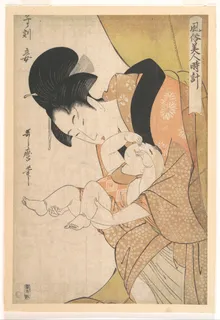 “Hour of the Rat: Mistress,” from the series Women’s Daily Customs (Fuzoku bijin tokei)Kitagawa Utamaro1790
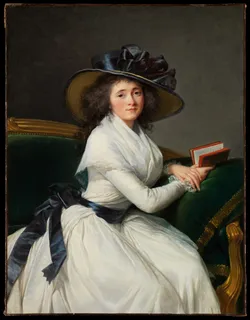 Comtesse de la Châtre (Marie Charlotte Louise Perrette Aglaé Bontemps, 1762–1848)Elisabeth Louise Vigée Le Brun1789
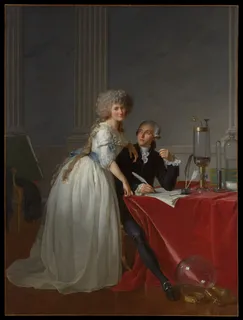 Antoine Laurent Lavoisier (1743–1794) and Marie Anne Lavoisier (Marie Anne Pierrette Paulze, 1758–1836)Jacques Louis David1788
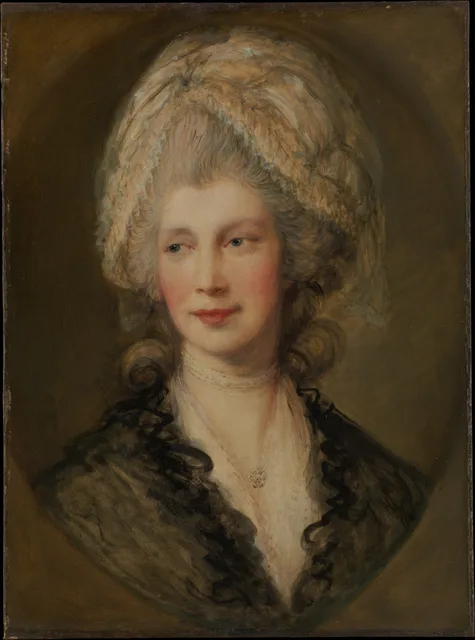 Queen CharlotteThomas Gainsborough1788
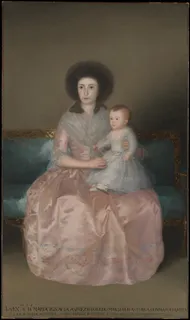 Condesa de Altamira and Her Daughter, María AgustinaGoya1787–88
Too good to keep to yourself
This painting,
for someone who comes to mind
They open it at full size
and see every brushstroke.
About this work
- Artist
- Francesco Guardi · 1712–1793
- Date
- 1780–93
- Medium
- Pen and brown ink, light brown wash, on two sheets of paper, joined.
- Size
- 34.9 × 67.6 cm
- Collection
- The Metropolitan Museum of Art
- Image
- Original long edge 4000px · shown at 2560px
- Original
- View on the museum's website ↗