Pyeongye
Painters · 19th century
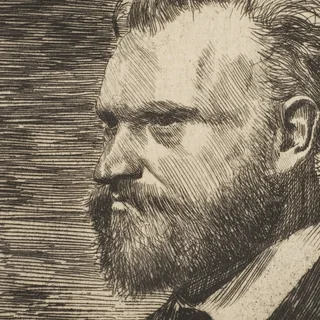
Edouard Manet
1832–1883
A Paris painter who was mocked and rejected again and again, yet kept knocking on the door of the official Salon and painted the people of his own day in big, bold strokes.
Scenes from a life
The life of Edouard Manet,
scene by scene
- 1849Rio de Janeiro
A seventeen-year-old from Paris watches a strange harbor come into view. Édouard had failed the entrance exam for the naval school. So in December 1848 he sailed from Le Havre as a trainee on a merchant ship, and in February 1849 he reached Rio de Janeiro. The plan was to gain sea time and try the exam again.
Back in France that summer, he failed it a second time. His father, a senior official in the Ministry of Justice, finally let him study art. Around 1850 Manet and his school friend Antonin Proust joined the studio of the painter Thomas Couture.
- 1861Paris
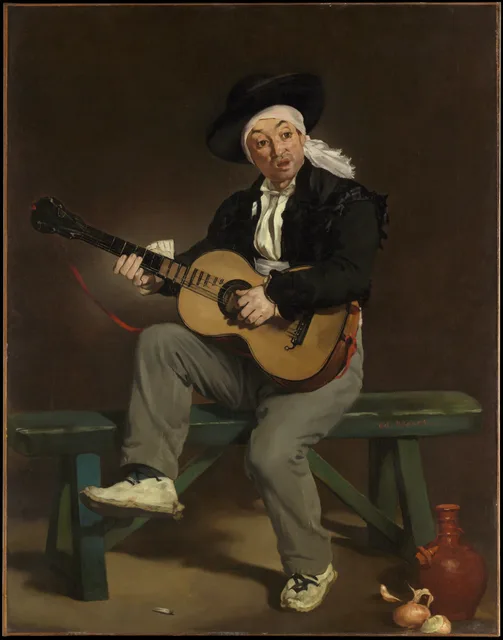
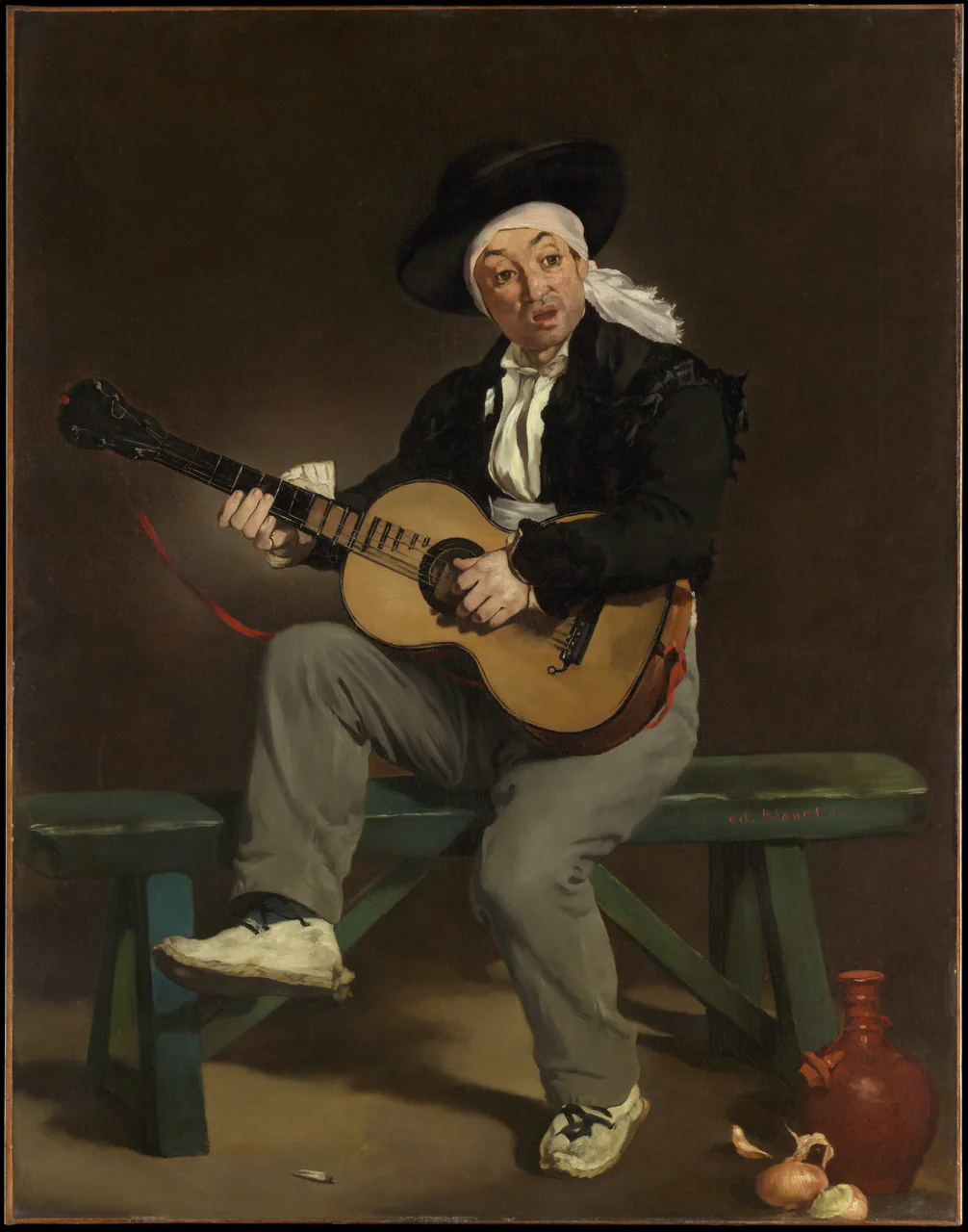
The Salon results are posted. Two years earlier Manet's Absinthe Drinker had been turned down. This time two of his pictures are hung: a portrait of his parents and The Spanish Singer. The singer won an honorable mention, and the poet Théophile Gautier praised it in print.
Look at the hands. The singer presses the strings with his right hand and plucks with his left, the reverse of a right-handed player. Manet had never been to Spain when he painted it.
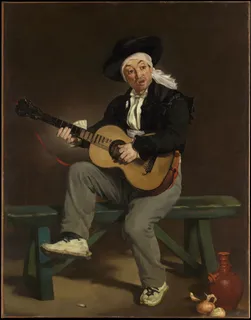 Painted around this timeThe Spanish Singer
- 1863Paris
So many paintings were rejected by the Salon jury that year that the complaints reached the emperor. Napoleon III allowed the rejected works to be shown in a separate exhibition, soon called the Salon des Refusés. Manet hung Luncheon on the Grass there: two dressed men picnicking beside a naked woman. Visitors laughed and fumed.
That October, in the small Dutch town of Zaltbommel, Manet married Suzanne Leenhoff. She was a pianist who had given piano lessons to the Manet brothers years before.
- 1865Madrid
His Olympia had caused another storm at the Salon that spring. In late summer Manet traveled to Spain for the first time. At the Prado in Madrid he finally stood in front of the Velázquez paintings he had admired for so long.
From Madrid he wrote to his friend, the painter Henri Fantin-Latour. Velázquez alone, he said, was worth the journey, and he called him the painter of painters. Manet did not stay long in Spain and was soon back in Paris.
- 1867Paris
The World's Fair opens in Paris. With no proper place for his work in the fair's art show, Manet built his own pavilion near the Place de l'Alma, at his own expense, and hung around fifty paintings. Courbet did the same that year.
The year before, the young writer Émile Zola had defended Manet in the press. In 1866 Manet painted a large picture of a young woman in a pink dressing gown, holding a little bunch of violets up near her chin. On a perch beside her, a gray parrot bows its head. The model was Victorine Meurent, the woman in Olympia.
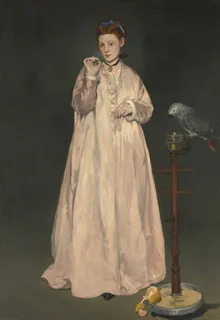 Painted around this timeYoung Lady in 1866
- 1870Saint-Germain-en-Laye
In February 1870 Manet slapped the critic Louis-Edmond Duranty in a café. He was angry about a lukewarm review Duranty had written of his work. Three days later the two men faced each other with swords in the forest of Saint-Germain-en-Laye, outside Paris.
Zola served as one of Manet's seconds. According to the written record that Zola and the other seconds signed, the blades clashed once so hard that both were bent, and Duranty got a small wound on his chest. That ended it. The two men soon made up and stayed friends until Duranty's death.
- 1874Gennevilliers
That spring Monet and his friends opened the show later called the first Impressionist exhibition. They wanted Manet with them, but he never sent work to it and kept sending to the Salon instead. That year the Salon showed his painting of a woman and a girl by the iron railings above a railway line.
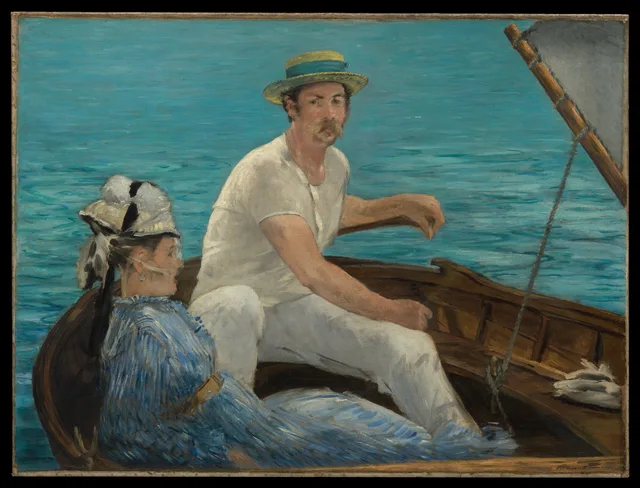
In summer he stayed at the family house in Gennevilliers on the Seine and often crossed to see Monet in Argenteuil. One day, while Manet painted Monet's family in their garden, Renoir dropped by and painted the same scene beside him. Boating comes from this summer. With no sky at all, only blue-green water behind them, a man in a straw hat holds the tiller and looks straight at us.
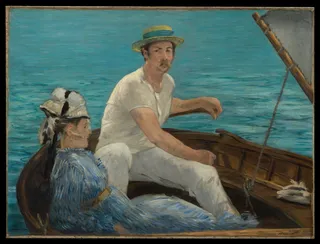 Painted around this timeBoating
- 1883Paris
At the end of 1881, after his old friend Antonin Proust became minister of the arts, Manet received the Legion of Honor. By then his health was failing badly. A Bar at the Folies-Bergère, shown at the Salon of 1882, became his last major painting.
On 20 April 1883 surgeons amputated his gangrenous left leg. Ten days later, on 30 April, Manet died at fifty-one. He was buried in Passy cemetery on 3 May, and Monet was called to Paris to be one of the six pallbearers.
In their own words
C'est le peintre des peintres.
He is the painter of painters. (Manet on Velázquez, in a letter to Fantin-Latour from Madrid, 1865)
People around them
- Suzanne Leenhoffthe Dutch pianist he married in 1863.
- Antonin Prousta school friend who entered Couture's studio with him and later became minister of the arts.
- Émile Zolathe writer who defended Manet in print and stood as his second in the duel.
- Victorine Meurentthe model for Luncheon on the Grass, Olympia and Young Lady in 1866.
- Claude Monetthe painter friend he spent the summer of 1874 with, and one of his pallbearers.
- Berthe Morisota painter who sat for Manet many times and in 1874 married his brother Eugène.