 Pyeongye
Artwork · 15th century · Hans Memling
LeoTurn on Magnifier at the lower right and move slowly across the painting.
Full screen opens it edge to edge.Tap the painting to fill the screen.
Spread two fingers to look closer.
At a glance
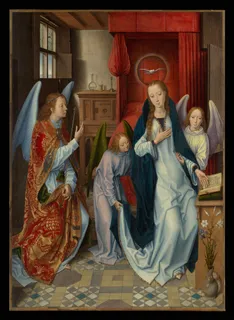
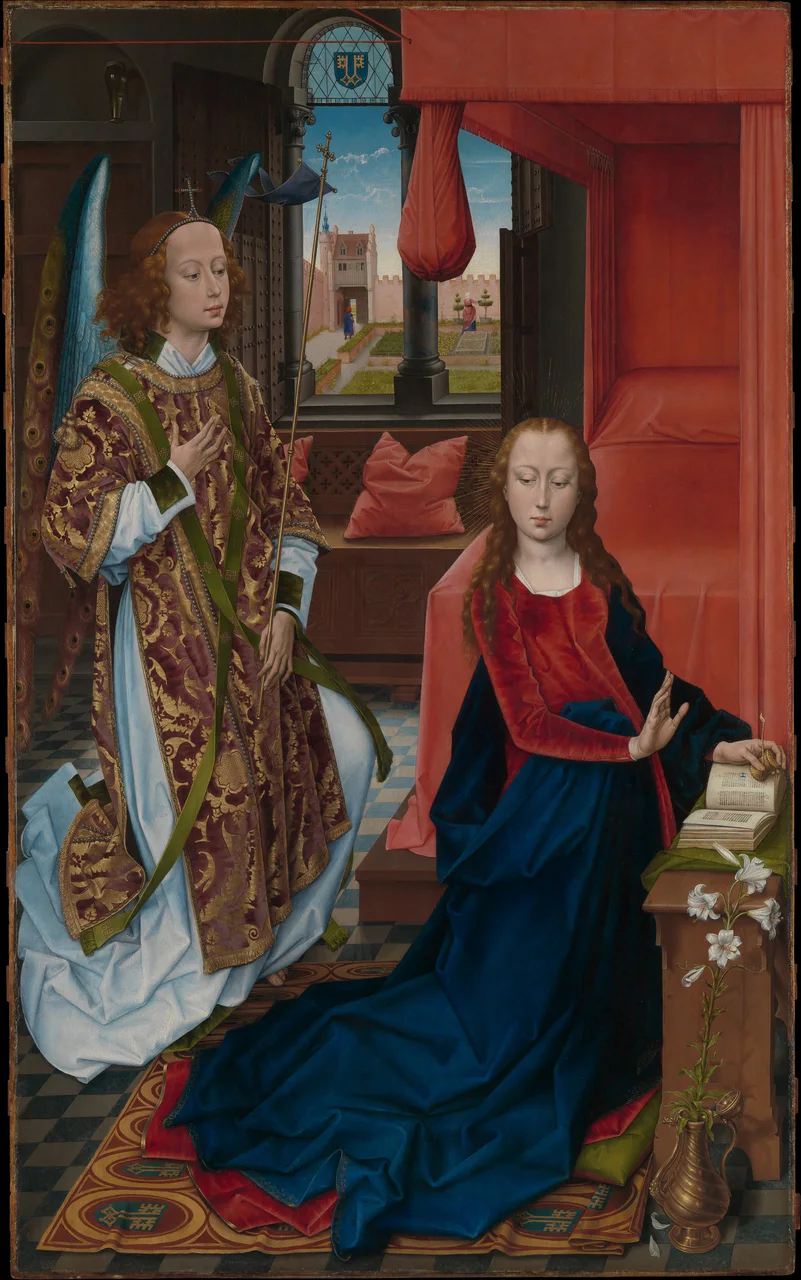
- The angel Gabriel enters Mary's room to tell her that she will bear the Son of God.
- Hans Memling, a painter working in the Flemish city of Bruges, painted it around 1465–70.
- The Bible story is set inside a wealthy fifteenth-century Flemish bedroom, so you can look closely at the bed, the rug, the vase, and the view outside.
Reading the picture
5 places to look closer
Tap a number on the painting to jump to its note, or a close-up to see that spot in the whole picture.
Zoom in on the window. Beyond it lies a garden enclosed by pink brick walls, with a gatehouse topped by a pointed tower. A man in a red hat and blue robe walks along the garden path, and a woman in red stands to the right. Just inside the window, a red bed curtain has been twisted up and tied into a hanging bundle.
Look at the angel's back. The tips of the wings are lined with the round eye markings of peacock feathers. The angel wears a red silk robe woven with gold patterns and edged with rows of pearls. A green band crosses diagonally past the hand resting on the chest.
Zoom in on Mary's hand. She raises one hand with the palm turned toward the angel. It looks like a startled, hesitant pause. Her other hand holds an open book on the lectern.
Look at the lower right. White lilies rise tall from a gleaming metal vase. Fine lines are drawn on every petal, and there are buds that have not opened yet. The white lily is a flower that stands for Mary's purity.
Zoom in on the rug at the lower left. Inside red and gold borders, blue ovals repeat a pattern of two keys set side by side. The painter even showed the corner of the rug folding up a little.
When it was painted
In 1465 a young painter from Germany named Hans Memling became a citizen of Bruges, the busy trading city in Flanders. Many scholars think that before he arrived he had worked in the Brussels workshop of Rogier van der Weyden. Rogier had died just the year before, in 1464.
This painting carries a strong trace of that older master. The Metropolitan Museum explains that the composition follows a design by Rogier. That raises an intriguing possibility, which the museum also suggests: the commission may have reached Rogier's workshop while he was still alive, with Memling finishing the work after his death.
So who ordered it? The clue is the keys. The pair of joined keys repeated on the rug and in the round stained-glass window is the coat of arms of the Clugny family. The museum believes the most likely patron was Ferry de Clugny, a churchman who advised the dukes of Burgundy and later became bishop of Tournai and a cardinal.
The panel is more than six feet tall, taller than most grown-ups. Memling went on to build a long career in Bruges, painting altarpieces and portraits for merchants and clergy, until his death in 1494.
Centuries later the panel entered the collection of the American banker J. Pierpont Morgan, and it was given to the Metropolitan Museum in 1917.
Now look again at the rug at the lower left. Half hidden under the edge of Mary's blue robe, those little keys have been quietly announcing the patron's family name for more than five hundred years.
Questions to think about
- Look for itIn the round stained-glass window at the very top, can you find a shield with the same two keys that appear on the rug?
- Why?Why do you think Memling set this world-changing message in a bedroom of his own day, instead of in the distant past?
- What about you?Mary raises her hand and pauses. If you suddenly heard news that would change your whole life, what do you think your first gesture would be?
Same period
Painted around the same time,
somewhere else
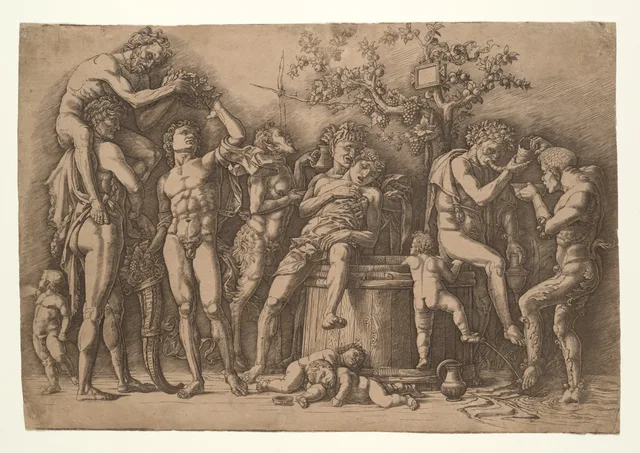 Bacchanal with a Wine VatAndrea MantegnaBefore 1475
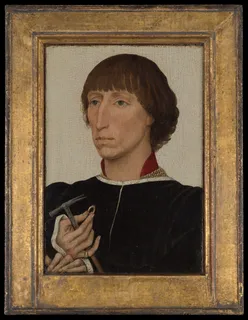 Francesco d'Este (born ca. 1429, died after 1486)Rogier van der Weydenca. 1460
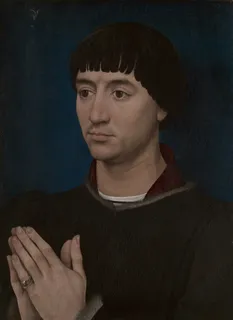 Portrait of Jean Gros (recto); Coat of Arms of Jean Gros (verso)Rogier van der Weyden1460–64
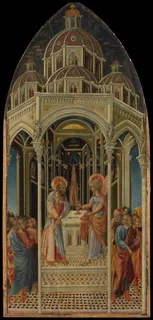 The Annunciation to Zacharias; (verso) The Angel of the AnnunciationGiovanni di Paoloca. 1455–60
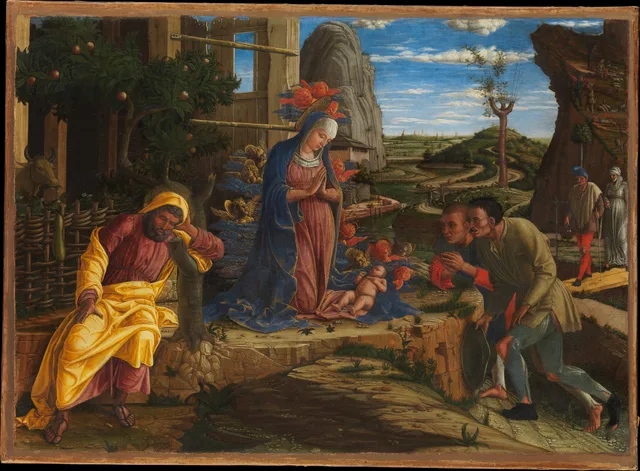 The Adoration of the ShepherdsAndrea Mantegnashortly after 1450
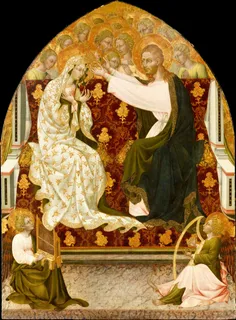 Coronation of the VirginGiovanni di Paoloca. 1455
Too good to keep to yourself
This painting,
for someone who comes to mind
They open it at full size
and see every brushstroke.
About this work
- Artist
- Hans Memling · 1465–1494
- Date
- ca. 1465–70
- Medium
- Oil on wood
- Size
- 186.1 × 114.9 cm
- Collection
- The Metropolitan Museum of Art
- Image
- Original long edge 3878px · shown at 2560px
- Original
- View on the museum's website ↗