 Pyeongye
Artwork · 15th century · Hans Memling
LeoTurn on Magnifier at the lower right and move slowly across the painting.
Full screen opens it edge to edge.Tap the painting to fill the screen.
Spread two fingers to look closer.
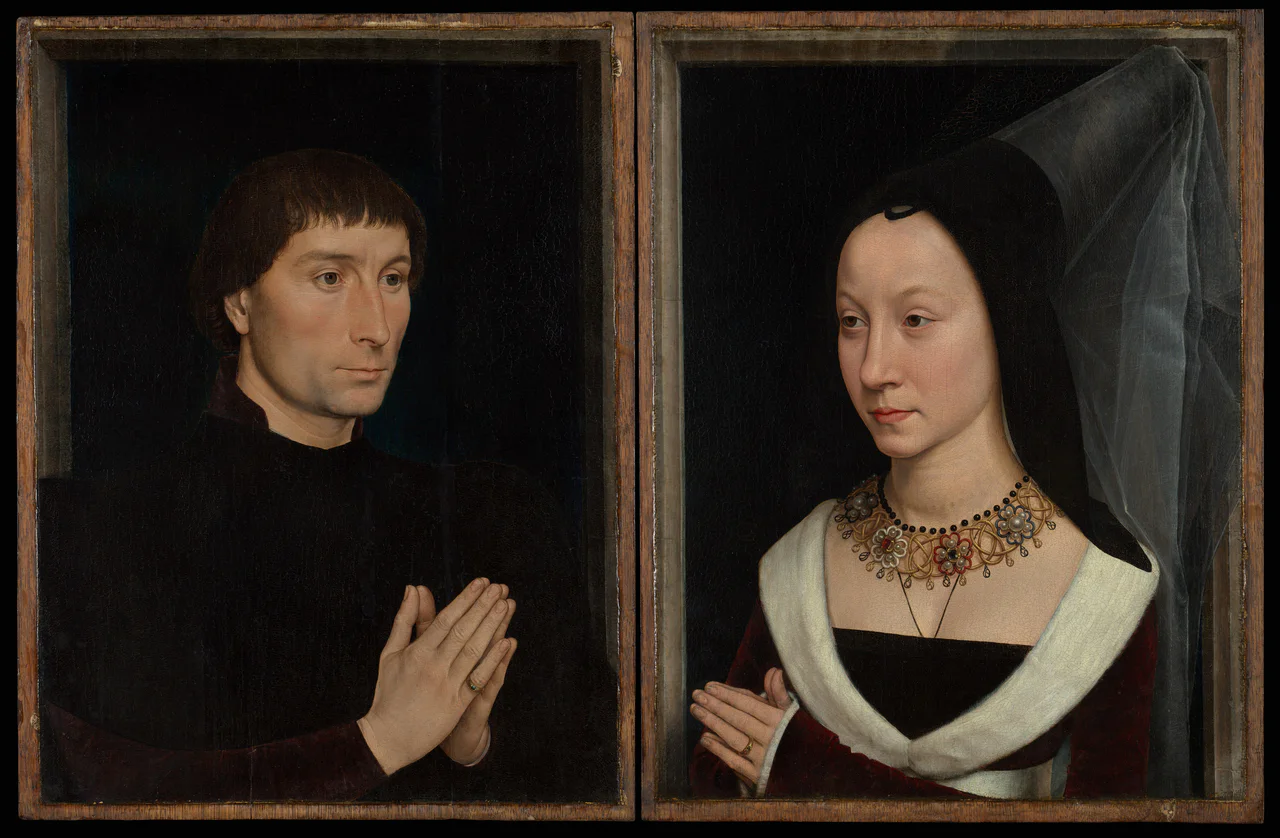
Tommaso di Folco Portinari (1428–1501); Maria Portinari (Maria Maddalena Baroncelli, born 1456)
Hans Memlingca. 1470Oil on oak44.1 × 33.7 cm
At a glance
- A husband, Tommaso Portinari, and his wife, Maria, each pray with folded hands on a separate small panel.
- Hans Memling, a painter working in Bruges, made them in oil on oak around 1470.
- He was born in 1428 and she in 1456, and Memling painted their faces, hands, and jewelry with a brush fine enough to pick out single pearls.
Reading the picture
5 places to look closer
Tap a number on the painting to jump to its note, or a close-up to see that spot in the whole picture.
Zoom in on the man's face on the left. You can see his neatly trimmed bangs, faint creases between his brows, and light running down the bridge of his nose. He is looking to the right, toward his wife.
Look at his folded hands. Every knuckle has its wrinkles, and on one finger he wears a gold ring set with a small green stone. Against his black clothes and the dark background, his hands seem to glow.
Now Maria's necklace. Gold cord is knotted into loops, and flower-shaped ornaments set with pearls hang along it. The petals are painted white, red, and blue, with a red stone or a dark stone at the center. A single row of black beads runs along the top.
Look behind Maria's head. Over her black headdress falls a very thin veil. Through it you can still see the dark background and the edge of the wooden frame. Memling made sheer fabric out of paint, and it is worth a long look.
Zoom in on Maria's hands too. Her slender fingers rise from a red sleeve with a white fur cuff, and she wears a gold ring with a tiny red stone. Husband and wife both wear rings and pray in the same pose.
When it was painted
Picture Bruges around 1470, a busy trading city in the north where Italian merchants and bankers lived and did business. Tommaso Portinari, a Florentine, ran the Medici bank's branch there. Around this time he married Maria Baroncelli, a fourteen-year-old from a Florentine family.
Memling, born in the German lands, had become a citizen of Bruges in 1465, and Italian clients kept coming to him. The Portinari couple turn up in another of his pictures too, a panel of scenes from Christ's Passion now in Turin. There they kneel in the corners as donors.
Paintings in this world traveled far, and sometimes they never arrived. Angelo Tani, who also worked for the Medici bank in Bruges, ordered a large Last Judgment from Memling. In 1473 the ship carrying it was seized by Paul Beneke, a privateer from Danzig, and the altarpiece is still in Gdańsk today.
Tommaso's own luck later ran out. He lent heavily to Charles the Bold, Duke of Burgundy, and when the duke was killed in battle in 1477, the money was lost. The Medici pulled out of the Bruges branch, and Tommaso died in 1501.
The couple also kneel, with their children, on the wings of the great Portinari Altarpiece by Hugo van der Goes, now in the Uffizi in Florence. These two small portraits came to The Met in 1913 with the bequest of Benjamin Altman.
Now look at the gap between the two panels. He turns to the right, she turns to the left, and both raise their hands in prayer. The Met believes a panel of the Virgin and Child once filled that middle space. It is lost, but their gazes still point to where it stood.
More by the same painter
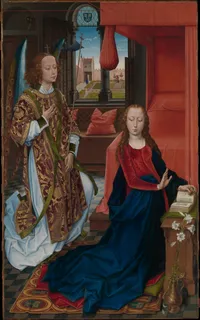
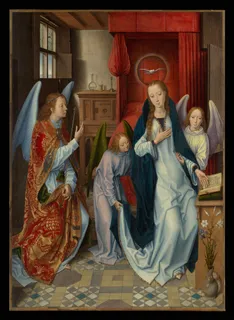
Questions to think about
- Look for itCan you find a ring on each of their hands? How are the stones different?
- Why?Why do you think Memling set the couple against a dark background and lit only their faces, hands, and jewels?
- What about you?Maria was about fourteen when she married a man twenty-eight years older. How should we think today about marriages arranged between families like this one?
Same period
Painted around the same time,
somewhere else
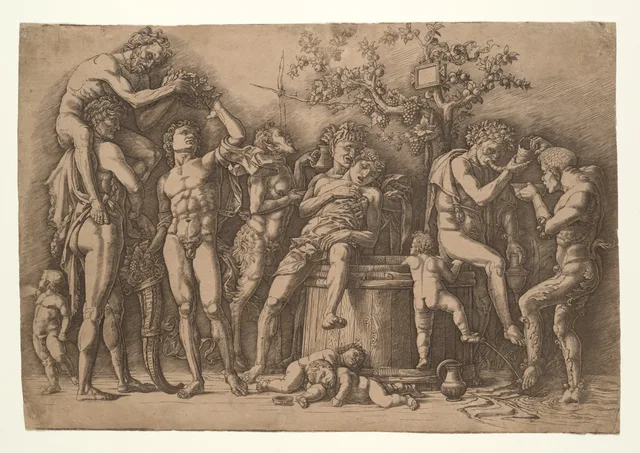 Bacchanal with a Wine VatAndrea MantegnaBefore 1475
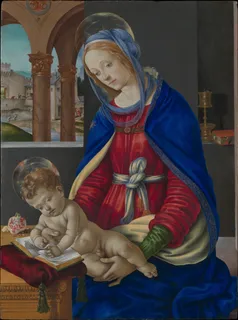 Madonna and ChildFilippino Lippica. 1483–84
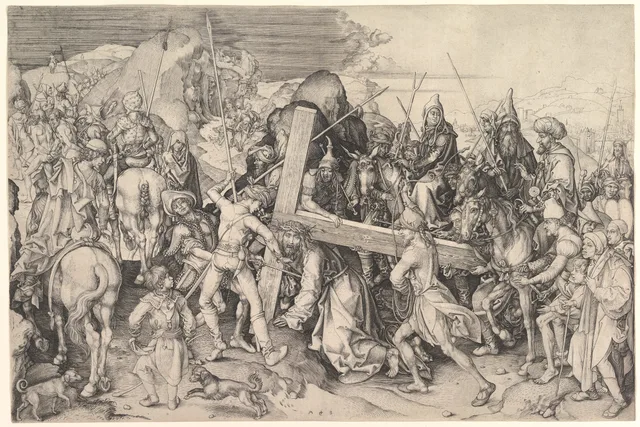 Christ Carrying the CrossMartin Schongauerca. 1475–80
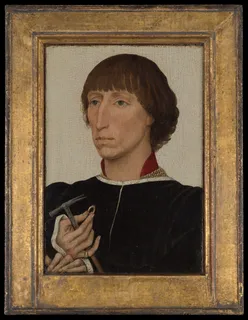 Francesco d'Este (born ca. 1429, died after 1486)Rogier van der Weydenca. 1460
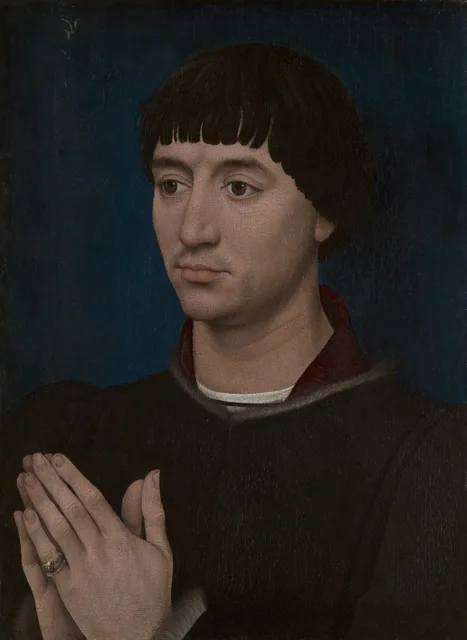 Portrait of Jean Gros (recto); Coat of Arms of Jean Gros (verso)Rogier van der Weyden1460–64
 The Annunciation to Zacharias; (verso) The Angel of the AnnunciationGiovanni di Paoloca. 1455–60
Too good to keep to yourself
This painting,
for someone who comes to mind
They open it at full size
and see every brushstroke.
About this work
- Artist
- Hans Memling · 1465–1494
- Date
- ca. 1470
- Medium
- Oil on oak
- Size
- 44.1 × 33.7 cm
- Collection
- The Metropolitan Museum of Art
- Image
- Original long edge 4000px · shown at 2560px
- Original
- View on the museum's website ↗