Pyeongye
Painters · 17th century
Nicolas Poussin
1594–1665
A Frenchman from a small Norman town who settled in Rome and turned ancient stories and orderly landscapes into pictures made for slow, careful looking.
Scenes from a life
The life of Nicolas Poussin,
scene by scene
- 1612Les Andelys
The painter Quentin Varin arrived in the little Norman town of Les Andelys. He had come to paint altarpieces for the town church. His paintings still hang there today.
Around this time Nicolas Poussin, about eighteen, left home for Paris. A working painter had just set up in his own town, and soon the young man was gone.
- 1622–23Paris
The Italian poet Giambattista Marino was living in Paris, and he took Poussin into his house. The early biographer Giovan Pietro Bellori wrote that Marino, kept indoors by illness, passed the time watching Poussin draw.
For Marino, Poussin made a set of fifteen drawings, eleven of them scenes from Ovid's Metamorphoses. Marino went back to Italy in 1623. In the spring of 1624 he finally reached Rome.
- 1628–30Rome
In February 1628 the body that ran St. Peter's Basilica gave Poussin a commission. He was to paint the altarpiece for the altar of Saint Erasmus. For a Frenchman only a few years in Rome, it was a big break. The painting was later replaced in the church by a mosaic copy, and it now hangs in the Vatican Museums.
Not every bid went his way. When the Chapel of the Virgin in San Luigi dei Francesi was to be decorated, the job went to Charles Mellin instead. Around then Poussin fell seriously ill, and the family of a Frenchman named Dughet nursed him. In 1630 he married their daughter, Anne-Marie Dughet.
- 1633–34Rome
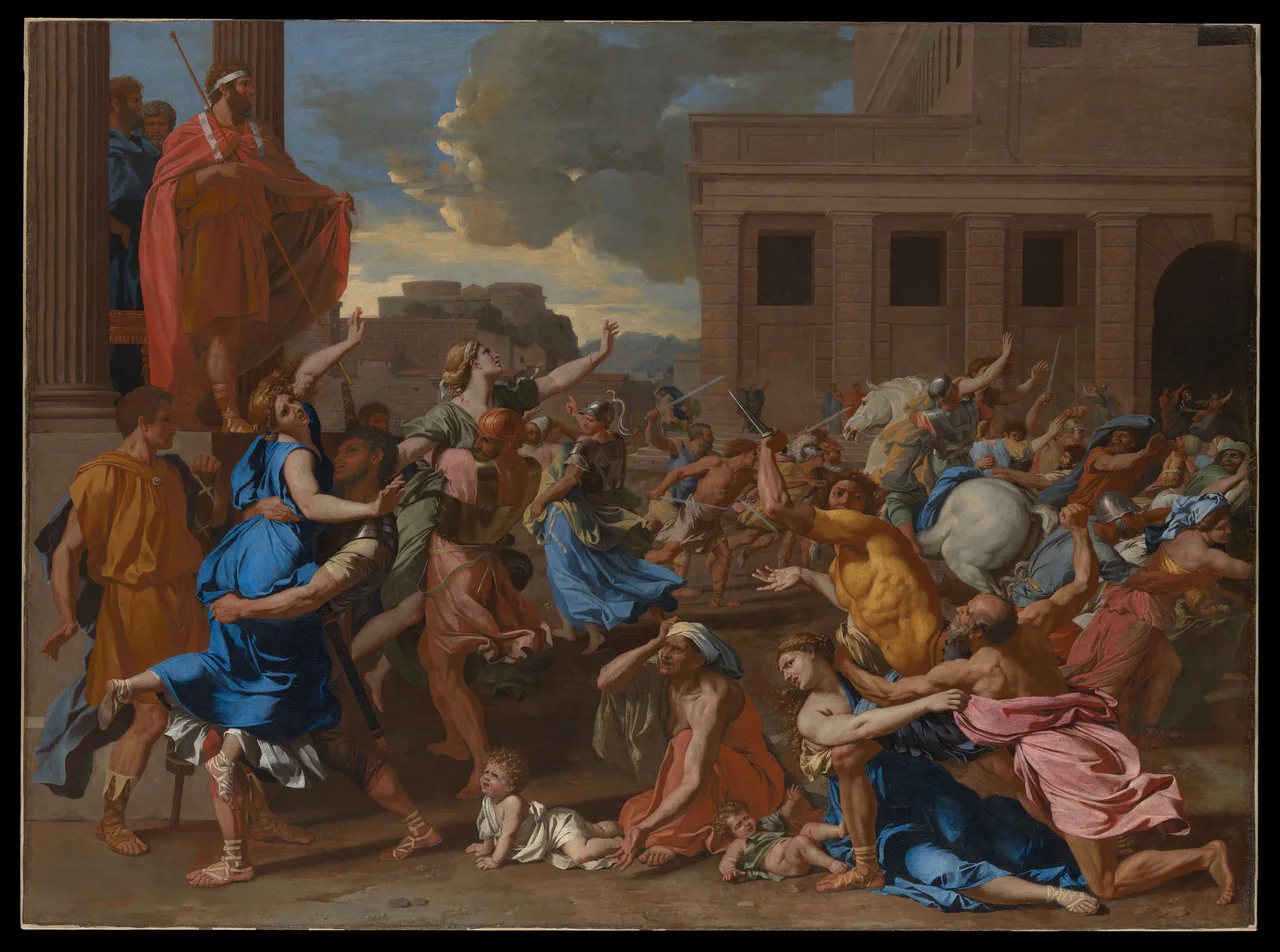
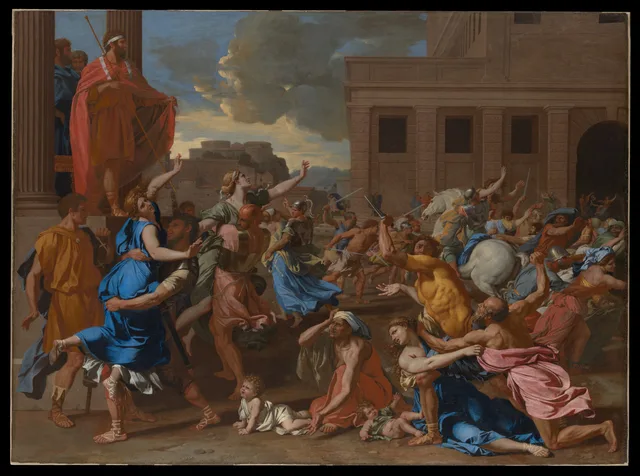
Before painting a crowd, Poussin built a tiny stage. Early writers said he modeled little wax figures, stood them in a box, and moved them and the light around until the groups worked. The Abduction of the Sabine Women comes from these years.
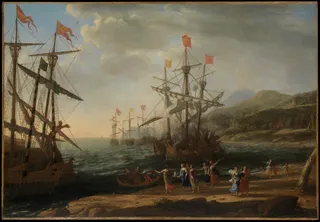
He also went outdoors. The German painter Joachim von Sandrart later wrote that he, Poussin, and Claude Lorrain rode out to Tivoli together to draw from nature. Two Frenchmen living in the same city stood in front of the same hills.
 Painted around this timeThe Abduction of the Sabine Women
- 1640Rome
Letters kept arriving from Paris. François Sublet de Noyers, who ran the king's building works, wanted Poussin back in France. Poussin did not want to leave Rome, and he stalled for a long time. In the end Paul Fréart de Chantelou traveled to Rome and brought him home.
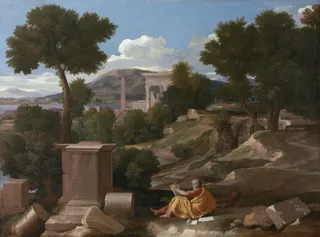
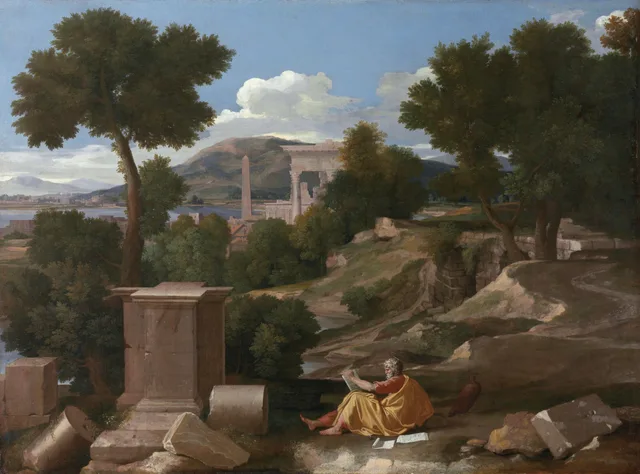
That same year Poussin painted Landscape with Saint John on Patmos. An old John sits wrapped in an yellow cloak, writing, with an eagle standing behind him. Broken columns lie at the lower left, and an obelisk and a temple rise in the distance. With Landscape with Saint Matthew, painted the same year, it may have been planned as part of a set of all four evangelists.
Painted around this timeLandscape with Saint John on Patmos - 1641–42Paris
Poussin reached Paris in December 1640. The king gave him a small house in the Tuileries garden and named him First Painter to the King. Work piled up at once: the Grand Gallery of the Louvre, title pages for the royal press, an altarpiece for a royal chapel.
The Paris painters were not pleased. Friction grew with the circle of Simon Vouet. In September 1642 he left for Rome, saying he would fetch his wife. He never came back.
- 1650Rome
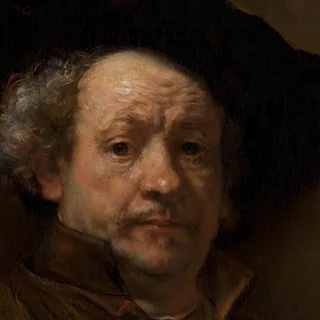
Chantelou had long wanted a portrait of his friend. He even suggested hiring a portrait painter in Rome. Poussin thought it over and decided to paint himself.
He ended up making two self-portraits. The first went to another patron, Jean Pointel, and is now in Berlin. The second carries an inscription naming Rome and the jubilee year 1650. That one went to Chantelou, and today it hangs in the Louvre.
- 1658–65Rome
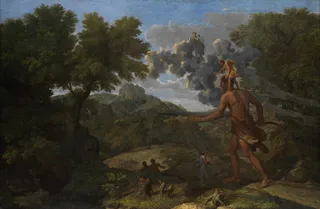
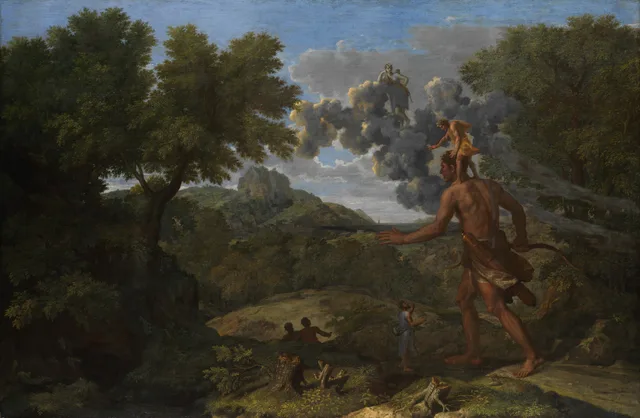
In old age Poussin's hand shook. In letter after letter he complained that the trembling slowed his work. Still, in 1658 he painted Blind Orion Searching for the Rising Sun for the French collector Michel Passart. A blind giant walks toward the dawn, steered by a small guide perched on his shoulder.
His wife Anne-Marie died in 1664. On November 19, 1665, Poussin died in Rome, and he was buried in the church of San Lorenzo in Lucina. His paintings later scattered. The Orion came to the Metropolitan Museum in New York in 1924, the Sabine Women followed in 1946, and the Art Institute of Chicago bought the Saint John in 1930.
Painted around this timeBlind Orion Searching for the Rising Sun
People around them
- Giambattista Marinothe Italian poet who took Poussin into his Paris house and commissioned drawings from him.
- Anne-Marie Dughetdaughter of the family that nursed Poussin through illness, and his wife from 1630.
- Gaspard Dughethis wife's younger brother, who learned painting from Poussin and became a landscape painter.
- Cassiano dal Pozzoa scholar of ancient Rome and one of Poussin's longest-standing patrons.
- Paul Fréart de Chantelouthe man who brought Poussin to Paris, and a lifelong correspondent and client.
- Claude Lorraina French landscape painter in Rome who went sketching at Tivoli with Poussin.
Works
Paintings by
Nicolas Poussin on Pyeongye
Contemporaries