Pyeongye
Painters · 17th century
Francisco de Zurbarán
1598–1664
A shopkeeper's son from a small town in western Spain who filled the monasteries of Seville with white robes and deep shadow, and who ended his days in Madrid.
Scenes from a life
The life of Francisco de Zurbarán,
scene by scene
- 1614Seville
A boy of fifteen arrives in Seville, the busy river port of Spain. His father, Luis de Zurbarán, was a haberdasher back home in Fuente de Cantos. In 1614 he placed his son for three years with a painter named Pedro Díaz de Villanueva. Today almost nothing by that teacher survives.
Another boy, a year younger, was learning to paint in the same city at the same time. His name was Diego Velázquez. The two would still be speaking up for each other more than forty years later.
- 1617Llerena
His training done, Zurbarán did not stay in the big city. He went back toward home, to the small town of Llerena. There, in 1617, he married María Paet, who was nine years older than he was. They had three children. Their son Juan, born in 1620, would grow up to be a painter too.
The marriage was short. María died after the birth of their third child. In 1625, with three small children at home, Zurbarán married again, this time Beatriz de Morales, a well-off widow.
- 1626Seville
In January 1626 the young painter from Llerena, then twenty-seven, signed a contract in Seville. The client was San Pablo el Real, a monastery of the Dominican friars. He promised them twenty-one paintings in eight months. It was a big job for an artist from a small town.
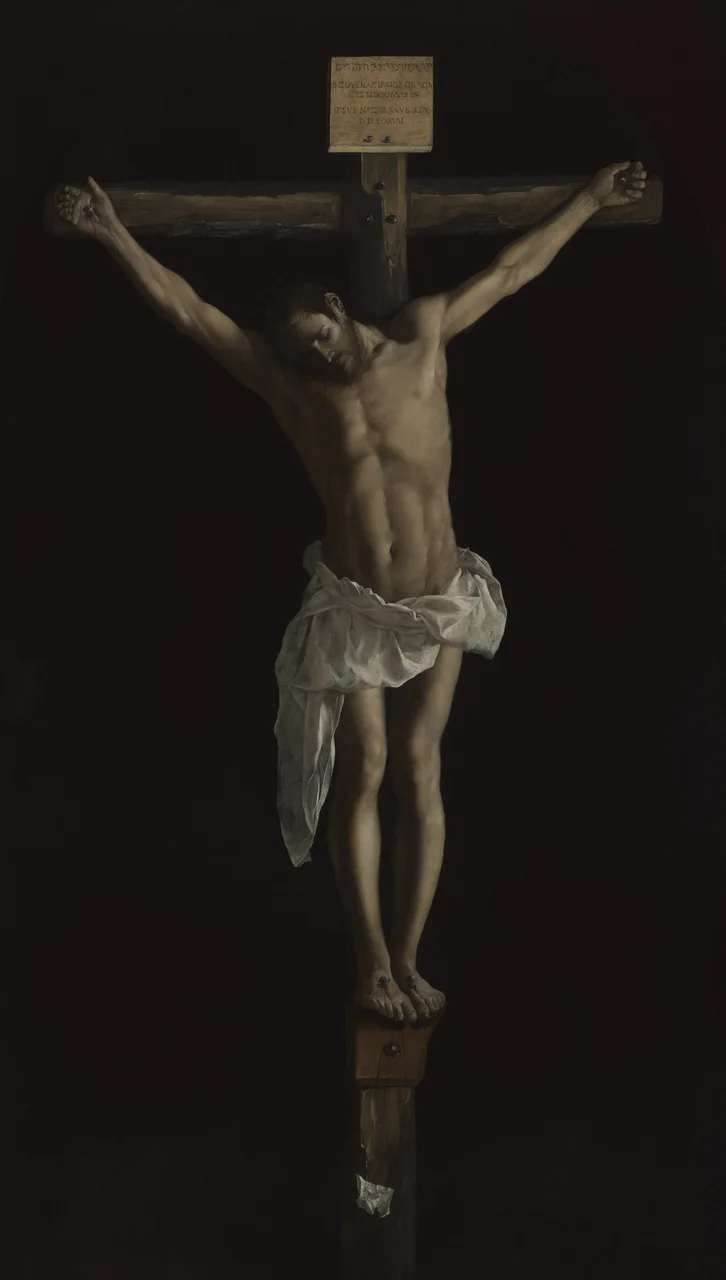
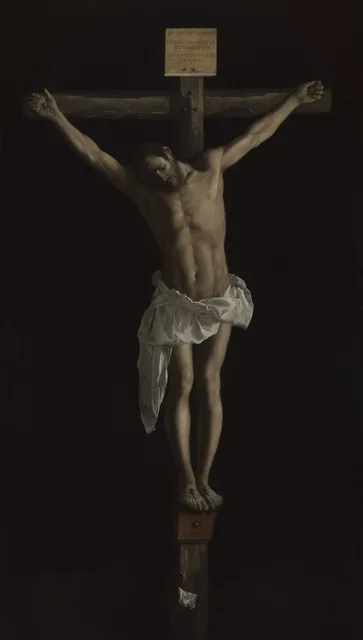
Look at The Crucifixion, finished the next year. There is no hill, no sky, no crowd. One body hangs in front of pure black, and only it catches the light. The white cloth at the waist shifts from pale to dark gray at every fold. The two feet are not crossed. Each has its own nail.
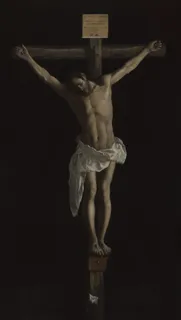 Painted around this timeThe Crucifixion
- 1630Seville
In 1629 the Seville city council asked Zurbarán to come and live in their city for good. The local painters did not like it. In May 1630 they demanded that he sit the painters' guild examination, like anyone else who wanted to work in Seville. The man who spoke for them was the painter Alonso Cano.
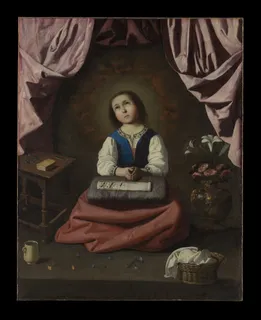
Zurbarán refused. He turned to the city council, pointing out that the city itself had invited him. He stayed and kept working for the monasteries. A few years later he painted The Young Virgin. A little girl has stopped her sewing, folded her hands, and turned her eyes upward. A half-finished strip of embroidery lies across the cushion on her lap.
Painted around this timeThe Young Virgin - 1634Madrid
In 1634 Zurbarán was called from Seville to the royal court in Madrid. King Philip IV was building a new palace, the Buen Retiro, and its great Hall of Realms needed paintings. Zurbarán took on ten scenes from the labors of Hercules and a picture of the defense of Cádiz against an English fleet.
It is a surprise in his work. A painter of monks and saints was suddenly painting a muscular hero and a battle. When the job was done he went home to Seville. The paintings are now in the Prado Museum in Madrid.
- 1647Seville
In 1647 the convent of La Encarnación in Lima, Peru, placed a large order with Zurbarán's workshop in Seville. The nuns wanted a series of life-size women saints. Seville was the port for ships to the Americas. Over the years his workshop, with his assistants doing much of the painting, sent pictures to places like Lima and Buenos Aires.
- 1649Seville
In 1649 plague swept through Seville, and a large part of the city died. Among the dead was Zurbarán's son Juan. He was twenty-nine, a painter trained by his father, and he had begun to be known for his still lifes.
Much had already changed at home. His second wife, Beatriz, had died in 1639. In 1644 Zurbarán married a third time, to Leonor de Tordera. Now, five years later, he lost the son from his first marriage.
- 1658Madrid
On December 23, 1658, Zurbarán, now sixty, gave testimony in Madrid. His old friend Velázquez was applying to join the Order of Santiago, a noble order of knights, and his family background was being checked. Zurbarán said he had known Velázquez for about forty years. Two boys who had learned to paint in Seville met again as old men.
He did not go back to Seville. He died in Madrid on August 27, 1664. The paintings he left in the monasteries of Seville were later scattered by war and by the closing of the religious houses. Today The Crucifixion hangs in the Art Institute of Chicago, and The Young Virgin in the Metropolitan Museum of Art in New York.
People around them
- Pedro Díaz de Villanuevathe Seville painter who taught him from 1614.
- Diego Velázqueza friend from their young days in Seville, for whom Zurbarán testified in 1658.
- Alonso Canothe painter who spoke for the Seville painters in 1630 when they demanded that Zurbarán take the guild exam.
- Juan de Zurbaránhis son by his first wife, a painter who died in the plague of 1649.
- Beatriz de Moraleshis second wife, married in 1625, who died in 1639.
- Leonor de Torderahis third wife, married in 1644.
Contemporaries