Pyeongye
Painters · 15th century
Hans Memling
1465–1494
A painter from the German lands who settled in the trading city of Bruges and painted Italian bankers, hospital brothers and sisters, and a young man of Bruges at prayer with a very fine brush.
Scenes from a life
The life of Hans Memling,
scene by scene
- 1465Bruges
On January 30, 1465, a clerk in Bruges writes a new name into the city's register of citizens: Jan van Mimnelinghe. The entry also records where he was born. It was Seligenstadt, a small town on the river Main.
Citizenship was the ticket to opening a workshop in Bruges. This line is the first trace Memling left in Flanders. A year earlier, the famous Brussels painter Rogier van der Weyden had died, and many scholars think Memling worked in Rogier's shop before he moved.
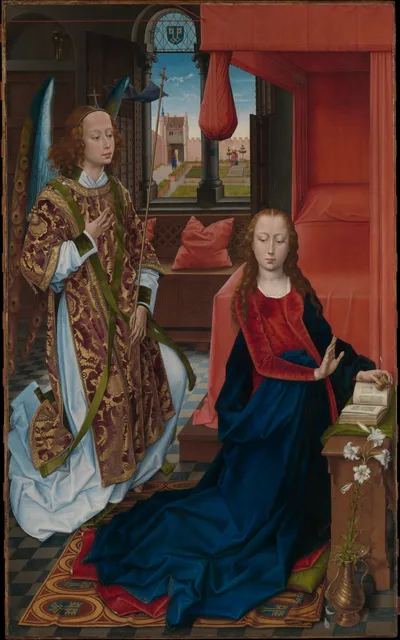
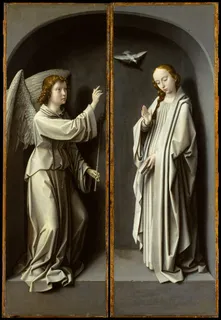
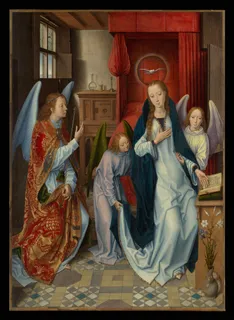
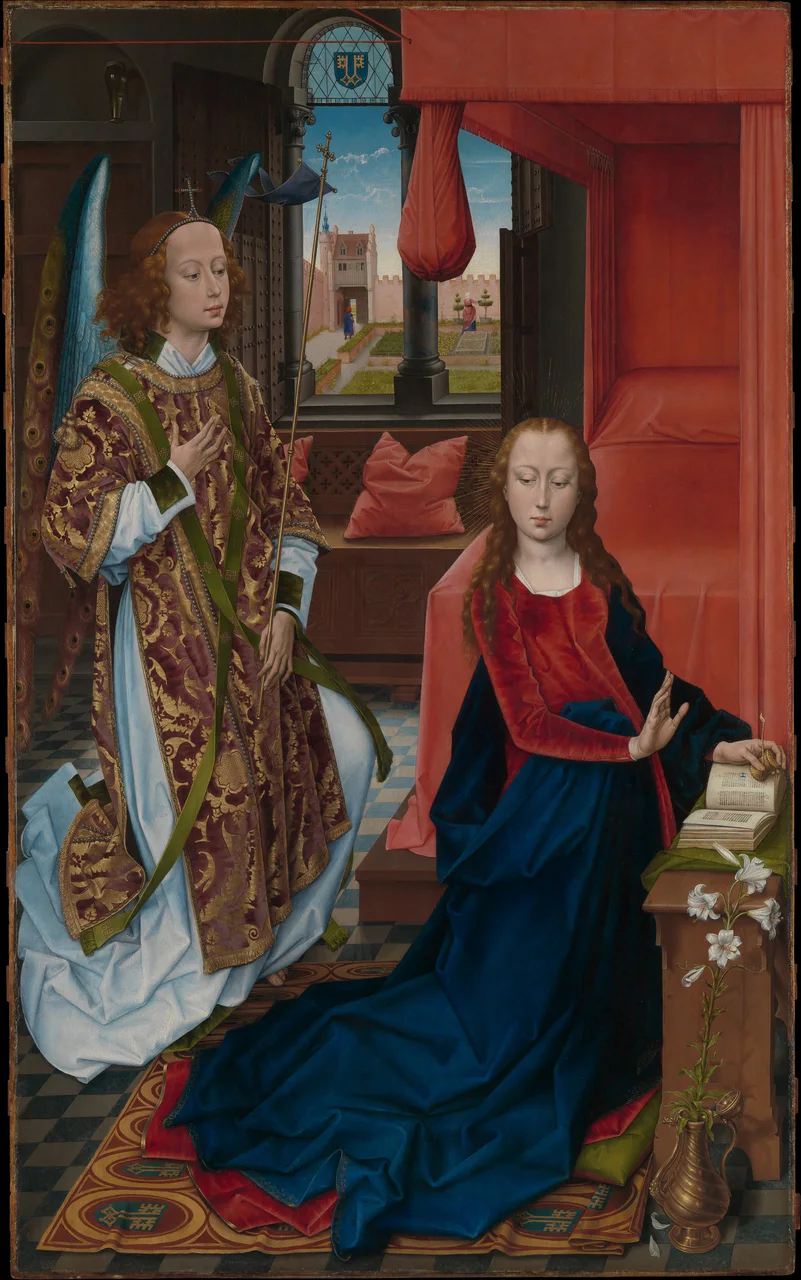
Look up at the round window in this early Annunciation. A shield with two crossed keys sits in the glass. It is read as the mark of the family who paid for the picture.
 Painted around this timeThe Annunciation
- 1470Bruges
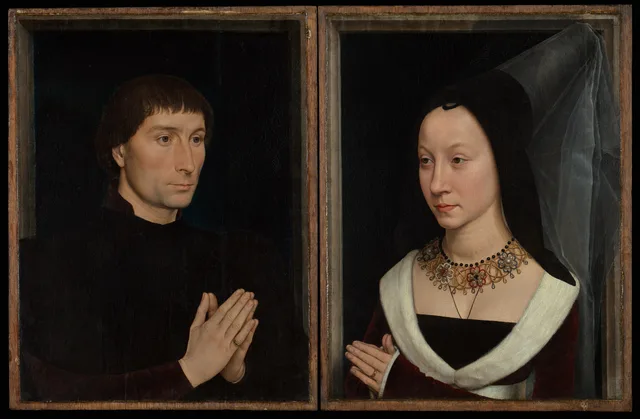
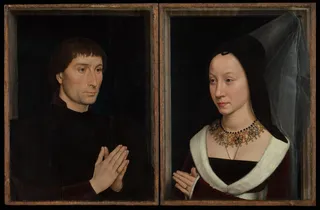
Tommaso Portinari, the Florentine who ran the Medici bank's branch in Bruges, gets married in 1470. His bride, Maria, came from the Baroncelli family back home in Florence. He was past forty. She was about fourteen.
The couple asked Memling to paint them at prayer, each on a separate oak panel. Find the gold ring on Tommaso's finger and the necklace of pearls and knotted gold at Maria's throat. Behind her head, a veil so thin that the wooden frame shows through it falls to her shoulder.
Painted around this timeTommaso di Folco Portinari (1428–1501); Maria Portinari (Maria Maddalena Baroncelli, born 1456) - 1473The North Sea
In April 1473, the galley San Matteo leaves Bruges for Italy and is attacked at sea. The raiders sail for Paul Beneke, a privateer captain from Danzig, the city we now call Gdańsk.
Among the cargo is Memling's huge Last Judgment triptych. Angelo Tani, another man of the Medici bank in Bruges, had ordered it for a chapel at the Badia Fiesolana near Florence. It never got there. It ended up in St. Mary's Church in Danzig, and it is still in Gdańsk today, in the National Museum.
- 1479St. John's Hospital, Bruges
In 1479, a tall three-part altarpiece by Memling goes up over the high altar of St. John's Hospital in Bruges. Its original frame carries his name and the year 1479. In the center, the two Saint Johns, the Baptist and the Evangelist, stand near the Virgin and Child.
The people who paid for it were the brothers and sisters who ran the hospital. Close the wings and you meet them: two brothers and two sisters kneeling with their patron saints.
- 1480Bruges
In 1480, Bruges raises a loan from its citizens to pay for war against France. Memling's name is on the list of wealthy townspeople who put up money.
Fifteen years after arriving as a stranger, the painter was a man of property. By now he had married Anna de Valkenaere, and they had three children.
In a later Annunciation from these years, Mary does not kneel. She stands, and two angels hold her up. On the cupboard behind her are a glass carafe half full of water and a brass candlestick.
Painted around this timeThe Annunciation - 1487Bruges
In 1487, Memling's wife Anna dies, leaving him with their three children.
That same year, a twenty-three-year-old from Bruges named Maarten van Nieuwenhove orders a two-panel picture from him. On one side sit the Virgin and Child. On the other, Maarten folds his hands in prayer. The frame says that Maarten had the work made, and gives the year, 1487, and his age, twenty-three. The diptych still hangs in the museum inside the old St. John's Hospital.
- 1489St. John's Hospital, Bruges
On October 21, 1489, St. John's Hospital holds a solemn ceremony. The relics of Saint Ursula are placed in a new shrine.
The shrine is a wooden box shaped like a little Gothic church. On its long sides Memling painted her story in six scenes: Ursula and her companions sail to Rome by way of Cologne and Basel, then die as martyrs at Cologne on the way back. The shrine is still in the same hospital building.
- 1494Bruges
On August 11, 1494, Memling dies in Bruges. A Bruges notary, Rombout de Doppere, notes it in his diary.
He writes that Memling came from Mainz and was buried at the church of St. Giles. He adds that people spoke of him as the most skilled painter in all of Christendom at the time.
His pictures later scattered across the sea. The Portinari portraits reached the Metropolitan Museum in New York in 1913, the Annunciation with the key-shaped coat of arms in 1917, and the Annunciation with the standing Mary in 1975.
People around them
- Rogier van der Weydenthe Brussels painter in whose workshop, many scholars think, Memling trained.
- Tommaso Portinarithe Florentine head of the Medici bank in Bruges, who had Memling paint him and his wife.
- Maria Baroncellithe young Florentine who married Tommaso in 1470 and appears in the matching portrait.
- Angelo Tania Medici bank man in Bruges who ordered the Last Judgment that was seized at sea.
- Anna de ValkenaereMemling's wife, who died in 1487 and left three children.
- Maarten van Nieuwenhovethe Bruges man who ordered a diptych from Memling in 1487, at twenty-three.
Works