 Pyeongye
Artwork · 19th century · Vincent van Gogh
LeoTurn on Magnifier at the lower right and move slowly across the painting.
Full screen opens it edge to edge.Tap the painting to fill the screen.
Spread two fingers to look closer.
At a glance
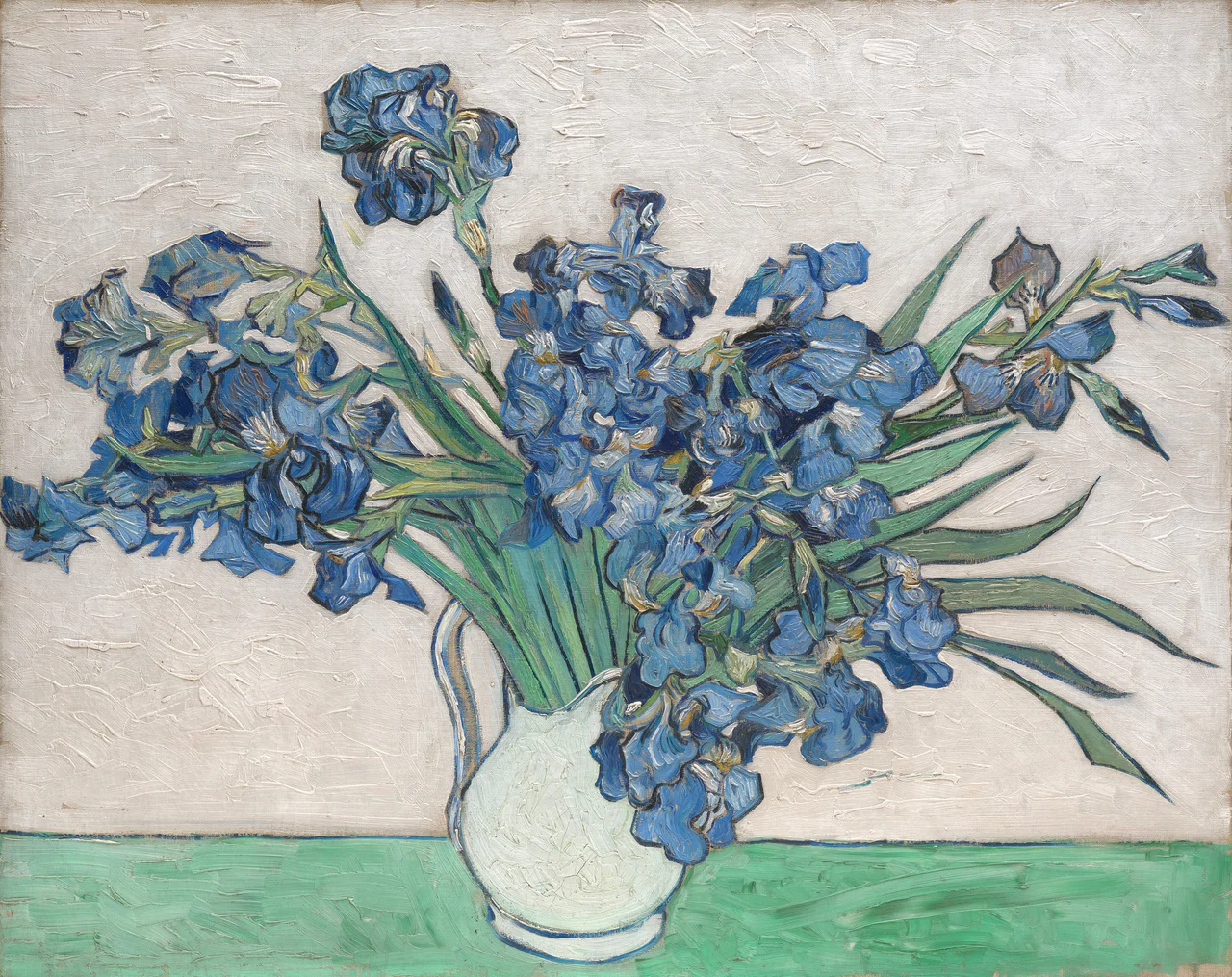
- A bunch of blue irises bursts out of a white jug, spilling far to the left and right.
- Vincent van Gogh painted it in May 1890, just before leaving the asylum at Saint-Rémy in southern France.
- The background, nearly white today, was once pink. Faded paint has changed how the whole picture looks.
Reading the picture
4 places to look closer
Tap a number on the painting to jump to its note, or a close-up to see that spot in the whole picture.
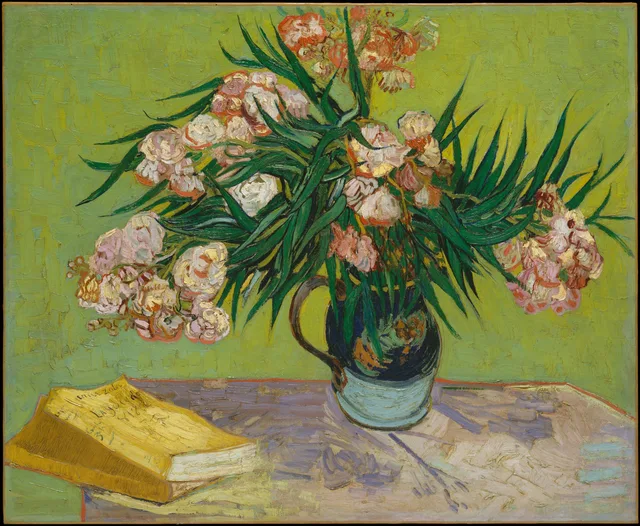
Start with the single flower rising at the very top. Every petal is fenced in by a dark blue outline. Inside, strokes of blue, sky blue, and white curve the way the petals bend. The creamy white at its center stands up off the canvas in a thick ridge.
Move to the far right. The upper flower there is a different color from the rest, a mix of brown and violet. The one below has opened wide to show white streaks and yellow spots at its heart. The stems and leaves shoot out like long blades, as if trying to leave the frame.
Zoom in on the jug. Its white body is outlined in blue, and the handle is just two blue lines. The white paint on the body is laid on so thick that fine cracks have formed in it. The tabletop is one cool, bright green.
Now look closely at the background at the upper left. Short, heavy swipes of pale paint run every which way, and you can see their raised edges. This area was pink when Van Gogh painted it. The red pigment in the mix faded in the light, leaving it almost white.
When it was painted
In May 1890 Van Gogh was thirty-seven and getting ready to leave. A year earlier, after a breakdown in Arles, he had checked himself into the asylum at Saint-Rémy. That spring had been hard. A long attack struck in February and kept him ill for about two months.
Once he recovered, he worked fast. His brother Theo had arranged for him to move north to Auvers-sur-Oise, near Paris, where Dr. Paul Gachet could look after him. In his last days at the asylum, Van Gogh painted four big bouquets: two of irises and two of roses.
On May 11 he described them in a letter to Theo. He was working on two large bunches of violet irises. One stood against a pink background, and he found the mix of greens, pinks, and violets soft and harmonious. The other burst out against yellow. This canvas is the pink one.
He left Saint-Rémy on May 16. About ten weeks later, in July, he died in Auvers.
The painting stayed with his family for years. In 1908 Theo's widow, Johanna van Gogh-Bonger, sold it to the Berlin dealer Paul Cassirer. Adele R. Levy gave it to the Metropolitan Museum in 1958. In 2015 the Met brought all four bouquets together for the first time since the artist's death.
Now look back at the flowers. Van Gogh called them violet, yet today most of them read as blue. The red that made his violet faded, just like the pink behind them.
The painter
Vincent van Gogh
1853–1890
When painting this, the artist was about 37 years old
All paintings by Vincent van Gogh →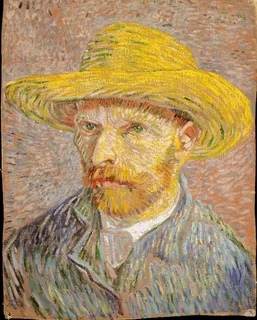
Questions to think about
- Look for itCan you find the iris whose color doesn't match the others?
- Why?Why might Van Gogh have let the flowers and leaves reach so far outside the jug?
- What about you?Paintings fade, like old photos. Should restorers try to bring back the original pink, or leave the picture as time has made it?
Same period
Painted around the same time,
somewhere else
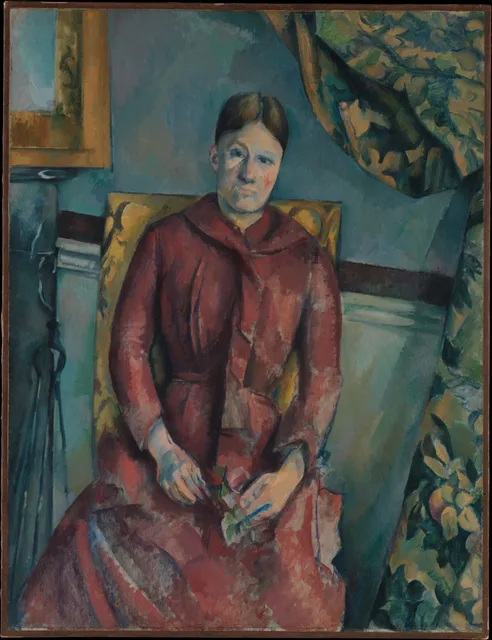 Madame Cézanne (Hortense Fiquet, 1850–1922) in a Red DressPaul Cézanne1888–90
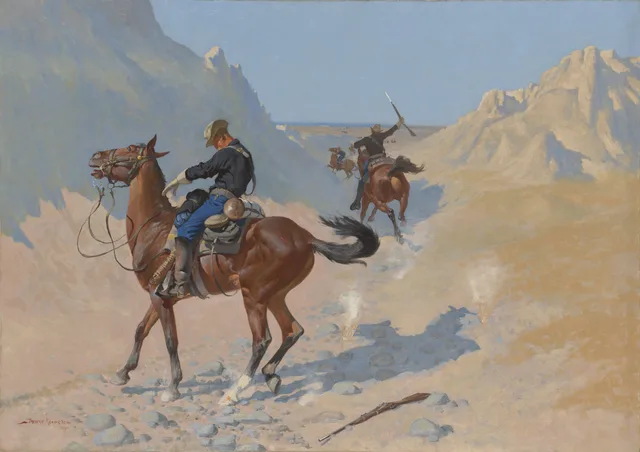 The Advance-Guard, or The Military Sacrifice (The Ambush)Frederic Remington1890
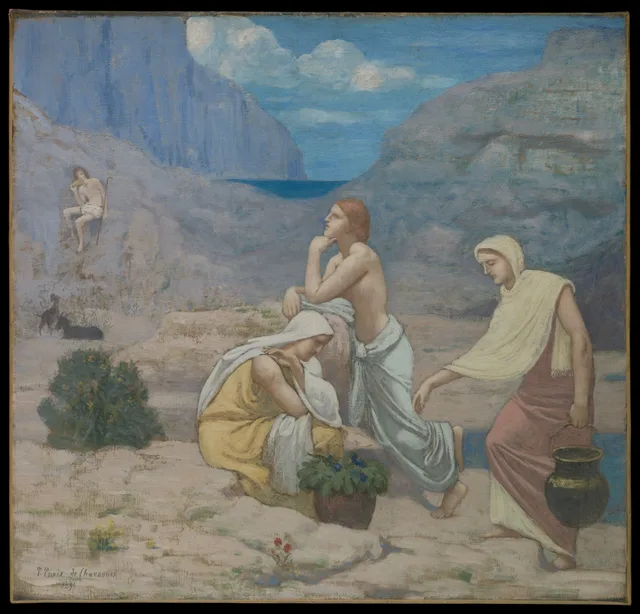 The Shepherd's SongPierre Puvis de Chavannes1891
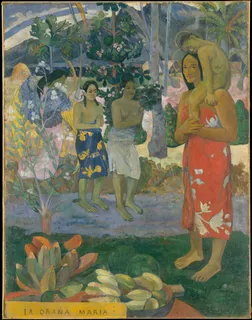 Ia Orana Maria (Hail Mary)Paul Gauguin1891
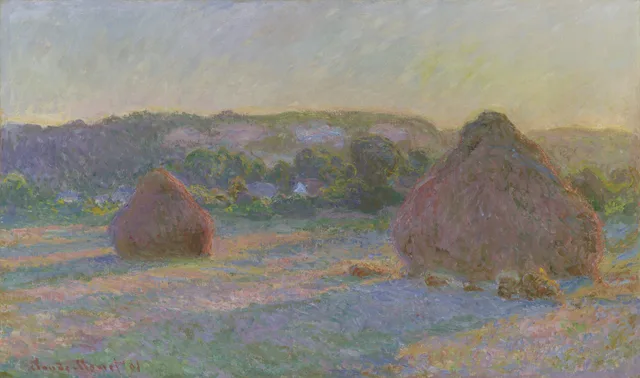 Stacks of Wheat (End of Summer)Claude Monet1890–91
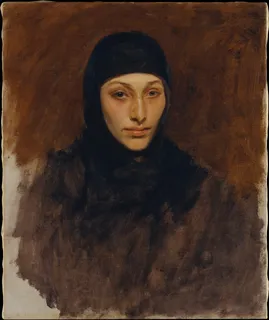 Egyptian WomanJohn Singer Sargent1890–91
Too good to keep to yourself
This painting,
for someone who comes to mind
They open it at full size
and see every brushstroke.
About this work
- Artist
- Vincent van Gogh · 1853–1890
- Date
- 1890
- Medium
- Oil on canvas
- Size
- 73.7 × 92.1 cm
- Collection
- The Metropolitan Museum of Art
- Image
- Original long edge 4000px · shown at 2560px
- Original
- View on the museum's website ↗