 Pyeongye
Artwork · 19th century · Vincent van Gogh
LeoTurn on Magnifier at the lower right and move slowly across the painting.
Full screen opens it edge to edge.Tap the painting to fill the screen.
Spread two fingers to look closer.
At a glance
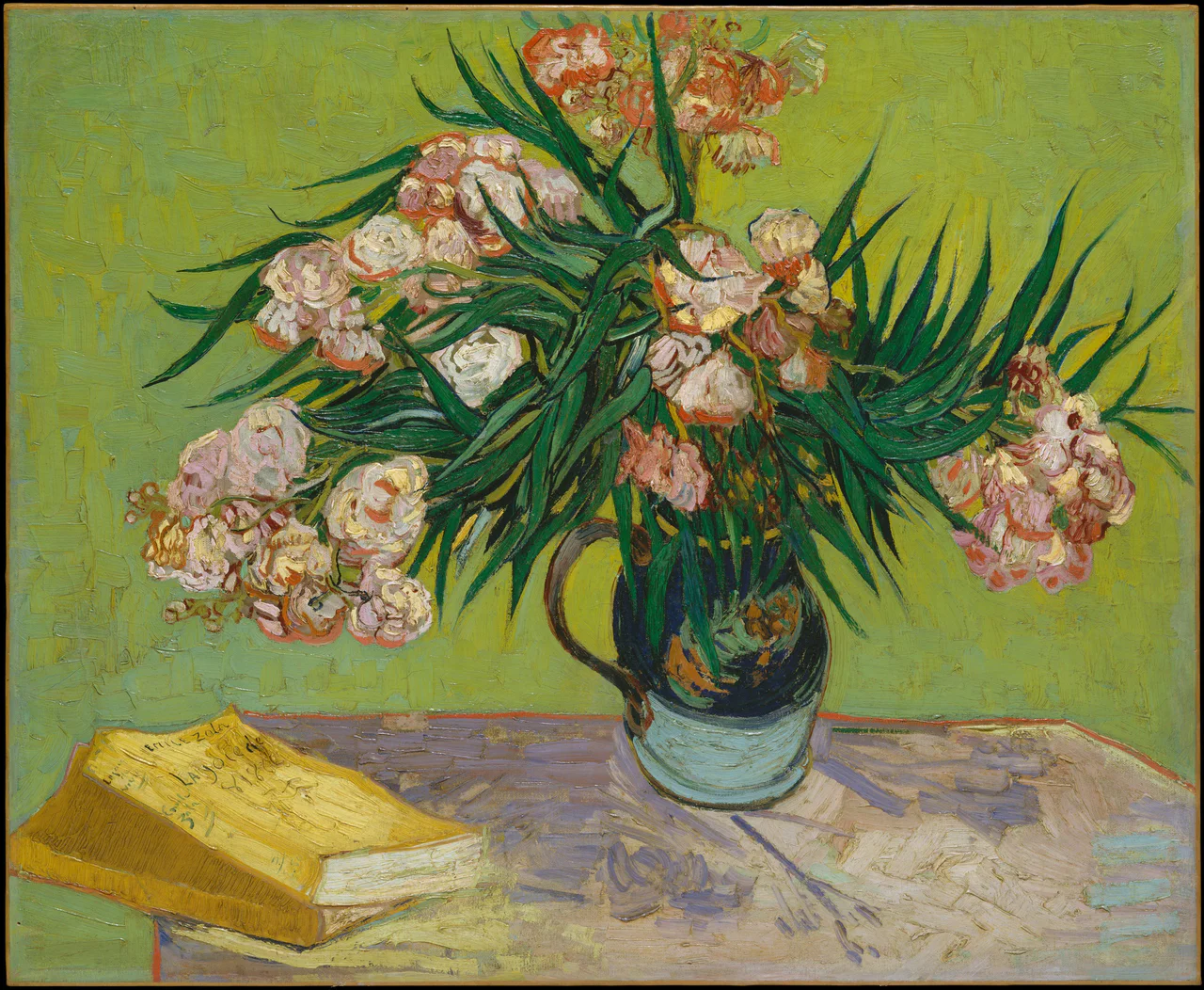
- Branches of oleander, heavy with pink and white blossoms, stand in a jug beside two yellow books.
- Vincent van Gogh painted it in 1888 in Arles, in the south of France.
- You can actually read the title on one of the books, which invites you to ask what the flowers and the novel are saying together.
Reading the picture
4 places to look closer
Tap a number on the painting to jump to its note, or a close-up to see that spot in the whole picture.
Start with the yellow book at the lower left. On the cover you can read Emile Zola, and below it, La Joie de vivre. It is a novel by Émile Zola, and the title means the joy of living. Van Gogh pushed thick yellow paint across the cover, then lettered the words straight onto it with his brush.
Zoom in on the jug in the middle. Its upper part is deep navy with orange and green patterns, and a band of pale jade wraps around the bottom. Long, pointed leaves pour down over it and tangle with the pattern. The handle is a single curving brown line.
Look at the cluster of blossoms on the left. Short, twisted strokes of pink, pale yellow, and white make the petals, edged with lines of orange. The paint is so thick that the flowers seem to stand up off the canvas. Against the yellow-green wall, the warm petals look even brighter.
Now the tabletop in front of the jug. Long violet strokes cut across it at an angle, again and again. They read like fallen leaves or shadows, and they keep the pale table from going flat. Along the back edge of the table runs a thin red line.
When it was painted
In 1888 Van Gogh was thirty-five and living in Arles, in the south of France. He had left Paris that February, chasing strong southern light and color. His paintings almost never sold. He lived on the money his brother Theo sent him.
In May he rented four rooms in the Yellow House on the Place Lamartine. He dreamed of a studio of the south, where artists would live and work side by side. The first painter he wanted there was Paul Gauguin. That summer he painted a run of sunflowers to decorate the room Gauguin would sleep in.
Flowers were good models that year. Oleander is a shrub that grows all around the Mediterranean. In a September letter to Theo, describing a painting of a public garden, he wrote that the bushes in the background were all oleanders, raving mad.
The yellow book has a past of its own. Zola's novel had already appeared in his Still Life with Bible, painted in Nuenen, in the Netherlands, in 1885. His father had died that year, and Vincent set this small yellow book in front of his father's huge Bible.
In October, Gauguin finally came. The two men painted together for about two months, but they clashed, and in December Van Gogh suffered a breakdown and cut his own ear. Long afterward, in 1962, Mr. and Mrs. John L. Loeb gave this canvas to the Metropolitan Museum.
Look again at the yellow book. In Nuenen it lay before his father's Bible, in a dark picture. In Arles it glows under an exploding bunch of flowers.
The painter
Vincent van Gogh
1853–1890
When painting this, the artist was about 35 years old
All paintings by Vincent van Gogh →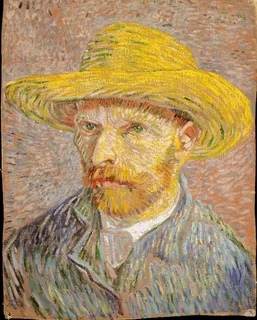
Questions to think about
- Look for itCan you find and read the author's name and the book's title on the cover?
- Why?Why do you think Van Gogh chose a novel called The Joy of Living to sit beside these flowers?
- What about you?If you picked a few things from your own desk to show who you are right now, what would they be?
Same period
Painted around the same time,
somewhere else
Too good to keep to yourself
This painting,
for someone who comes to mind
They open it at full size
and see every brushstroke.
About this work
- Artist
- Vincent van Gogh · 1853–1890
- Date
- 1888
- Medium
- Oil on canvas
- Size
- 60.3 × 73.7 cm
- Collection
- The Metropolitan Museum of Art
- Image
- Original long edge 3811px · shown at 2560px
- Original
- View on the museum's website ↗