Pyeongye
Painters · 19th century
Vincent van Gogh
1853–1890
A Dutch painter who decided at twenty-seven to become an artist and, in about ten years of work, left the world he saw in thick brushstrokes and in hundreds of letters to his brother.
Scenes from a life
The life of Vincent van Gogh,
scene by scene
- 1869The Hague
Vincent was born in 1853, the son of a village pastor in the Netherlands. At sixteen he started work at Goupil & Cie, an art dealer in The Hague, thanks to an uncle in the picture trade. He moved on to the firm's branches in London and Paris. But his heart was never in selling, and in 1876 he was let go.
- 1880The Borinage
In the Borinage, a coal-mining district in Belgium, Vincent tried to live as a preacher among the miners. The church did not renew his temporary post. He began filling notebooks with drawings of miners and their families, and in 1880, at twenty-seven, he decided to become an artist. Around then his younger brother Theo began sending him money. Their letters to each other would run until Vincent's death.
- 1887Paris
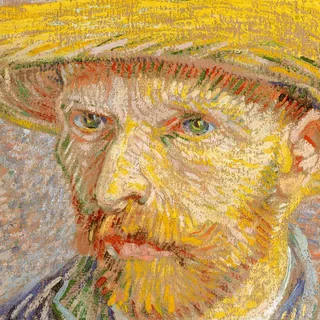
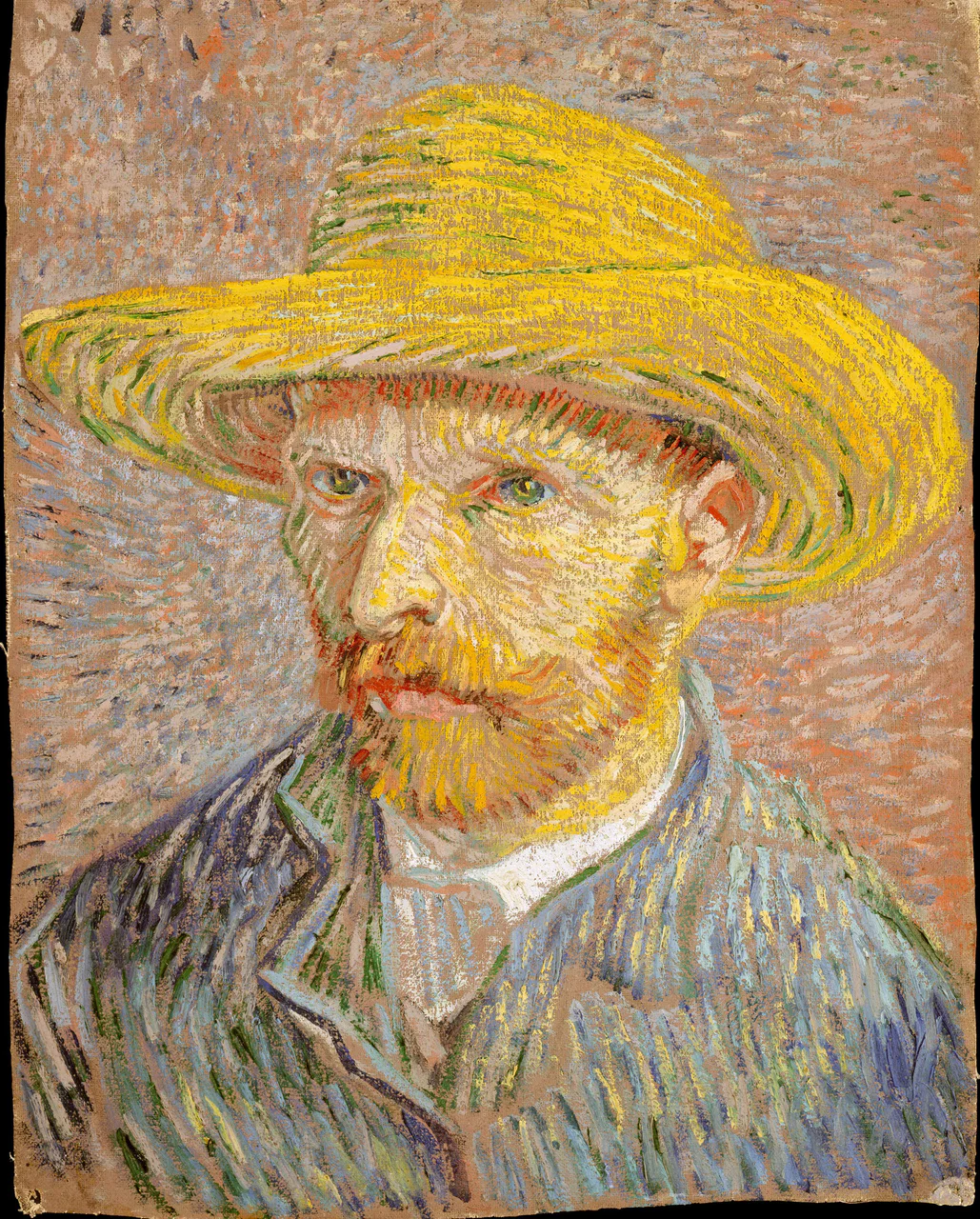
Living with Theo in Montmartre, Vincent saw Impressionist paintings and Japanese prints, and his dark brown palette gave way. Look at Self-Portrait with a Straw Hat. The hat is built from short strokes of yellow and green; the jacket is a thicket of blue and green dashes. On the back of the same canvas is The Potato Peeler, painted two years earlier in the Dutch village of Nuenen. Short on money for models, he painted his own face in the mirror again and again, and he saved on canvas too.
 Painted around this timeSelf-Portrait with a Straw Hat (obverse: The Potato Peeler)
- 1888Arles
In February 1888, Vincent headed south to Arles in search of strong sunlight. In Oleanders, painted that summer, pink blossoms and blade-like leaves burst out of a jug. Now look at the yellow books in the lower left. On the top cover you can make out the title of Émile Zola's novel La Joie de vivre. He rented the Yellow House and dreamed of turning it into a studio where artists could live and work together.
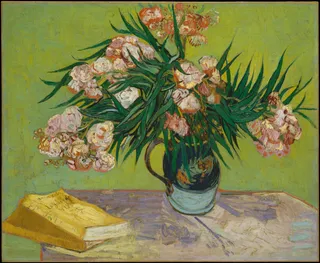 Painted around this timeOleanders
- 1888The Yellow House, Arles
In Arles, Vincent grew close to the family of Joseph Roulin, a postal worker, and painted every one of them. In Madame Roulin and Her Baby, little Marcelle, born that summer, stares straight at us from under a white bonnet. Her mother's face is pushed to the right edge, but the hands holding the baby are big and steady. In October Paul Gauguin arrived at the Yellow House. Two months later, after a bitter quarrel, Vincent cut off his own ear.
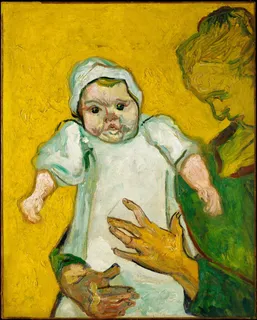 Painted around this timeMadame Roulin and Her Baby
- 1889Saint-Rémy
After repeated attacks of illness, Vincent checked himself into the asylum at Saint-Rémy in May 1889. He painted the fields around it. On the right of Wheat Field with Cypresses, a dark green cypress shoots upward like a flame. The clouds are laid on thickly so they seem to churn, and tiny red flowers are scattered along the bottom of the wheat.
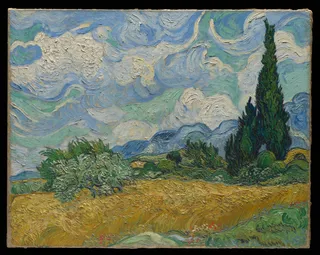 Painted around this timeWheat Field with Cypresses
- 1890Saint-Rémy
In May 1890, just before he left the asylum, Vincent painted one bouquet after another. In Irises, blue flowers spill out of a white jug. In Roses, white blooms tumble over a green vase. The museum explains that the roses were originally pink; a red pigment has faded, leaving them white.
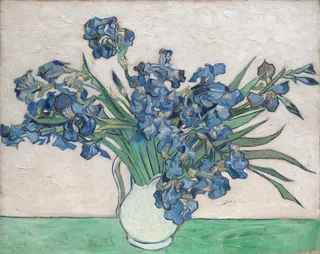 Painted around this timeIrises
- 1890Auvers-sur-Oise
In late May he moved to Auvers-sur-Oise, a village north of Paris, and for two months painted almost a picture a day. On July 27 he was wounded by a gunshot, and two days later he died, at thirty-seven. Theo died about six months after him. Theo's widow, Jo Bonger, kept the paintings and letters together and worked to make them known.
In their own words
la vue des étoiles me fait toujours rêver
The sight of the stars always makes me dream. Vincent wrote this to Theo from Arles in the summer of 1888.
People around them
- Theo van Goghhis younger brother, an art dealer, who supported him for the rest of his life and wrote to him constantly.
- Paul Gauguinthe painter who shared the Yellow House in Arles with him for two months in the fall of 1888.
- Joseph Roulinthe postal worker in Arles whose whole family Vincent painted.
- Augustine RoulinJoseph's wife, painted with baby Marcelle.
- Anton Mauvea Hague painter married into his mother's family, who gave Vincent lessons when he was starting out.
- Jo BongerTheo's wife, who preserved the paintings and letters after both brothers died.
Works
Paintings by
Vincent van Gogh on Pyeongye
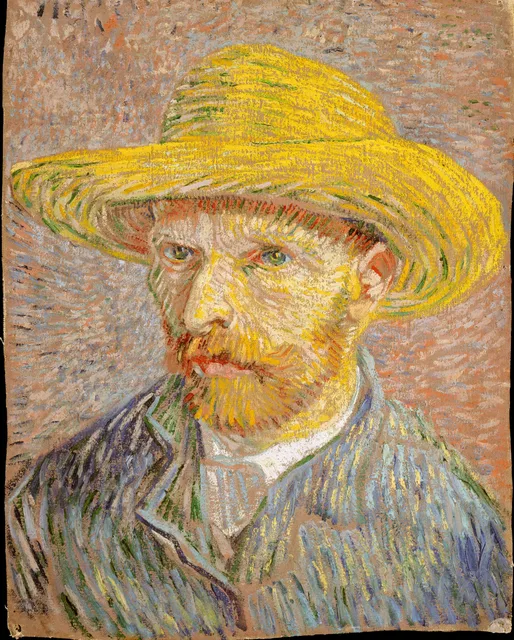 Self-Portrait with a Straw Hat (obverse: The Potato Peeler)1887Madame Roulin and Her Baby1888
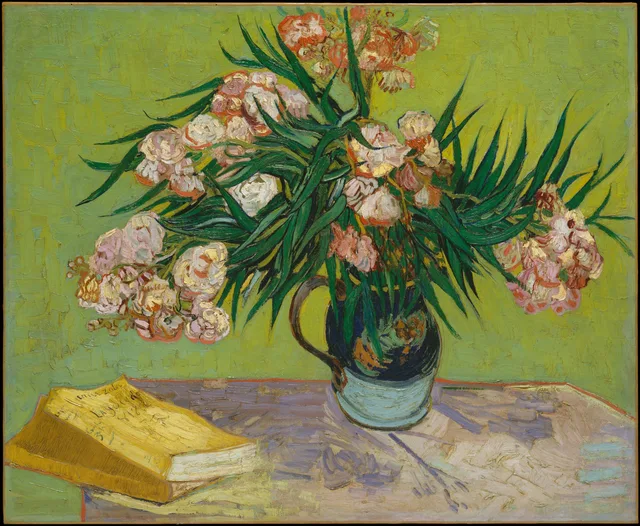 Oleanders1888
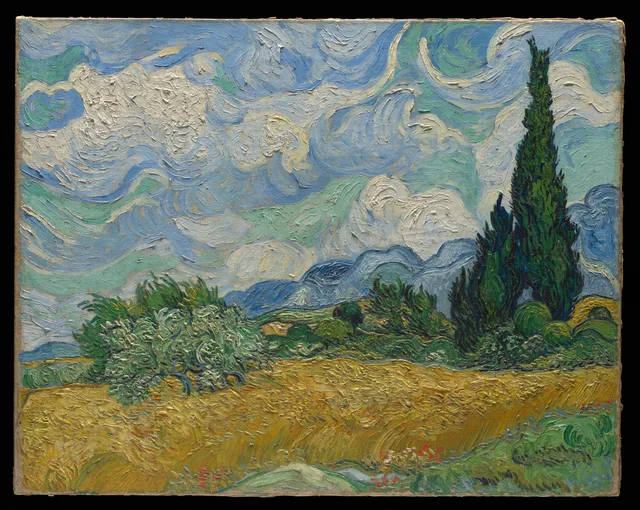 Wheat Field with Cypresses1889
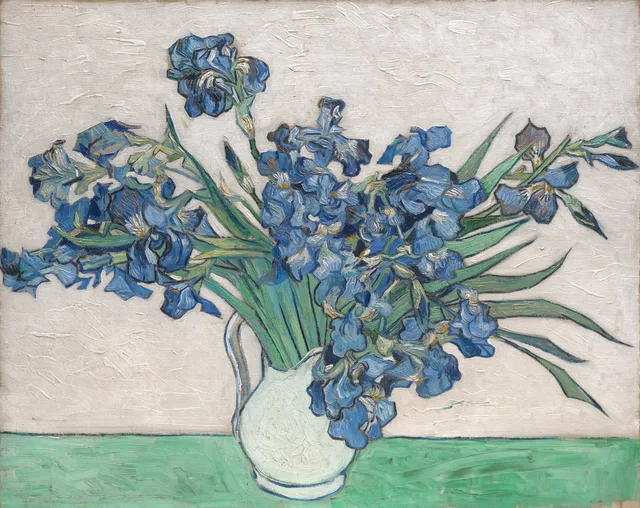 Irises1890
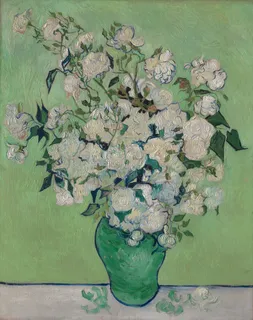 Roses1890
Hidden stories in Vincent van Gogh's paintings